
Welcome to The Uncertain Times. As the World Cup hots up, we’re interested in what’s happening off-pitch.
This week alone: a denim brand won the internet by having its logo covered up, a consumer goods giant deployed 50,000 creators and a sportswear company turned the UAE desert into a video game.
But UK under 16s will have to find other ways to view social content, as Keir Starmer announced banning teens from social channels.
The topics we’re keeping score on this week:
- Levis’s proves the power of the logo – without even fully showing theirs
- Unilever takes marketing off-pitch, partnering with 50,000 creators to generate World Cup-related content that’s social-first
- Asda leads with experience and launches a multi-brand in-store World Cup activation
- Adidas turns the UAE desert into a Rocket-League inspired playground
- UK under 16s are kicked off social media
- 69% of consumers ditch out on brands they no longer trust, according to McCann
Levi’s proves the power of the logo – without showing it
Under FIFA’s ‘clean stadium’ policy, venues hosting World Cup matches must remove or cover commercial branding from any brands not sponsoring the event.
Thus, Levi’s Stadium in Santa Clara became ‘San Francisco Bay Area Stadium’ for the duration of the tournament.
Levi’s complied – technically – by covering their stadium logo with a white tarp. Only, the tarp retained the exact outline of the brand’s iconic batwing.
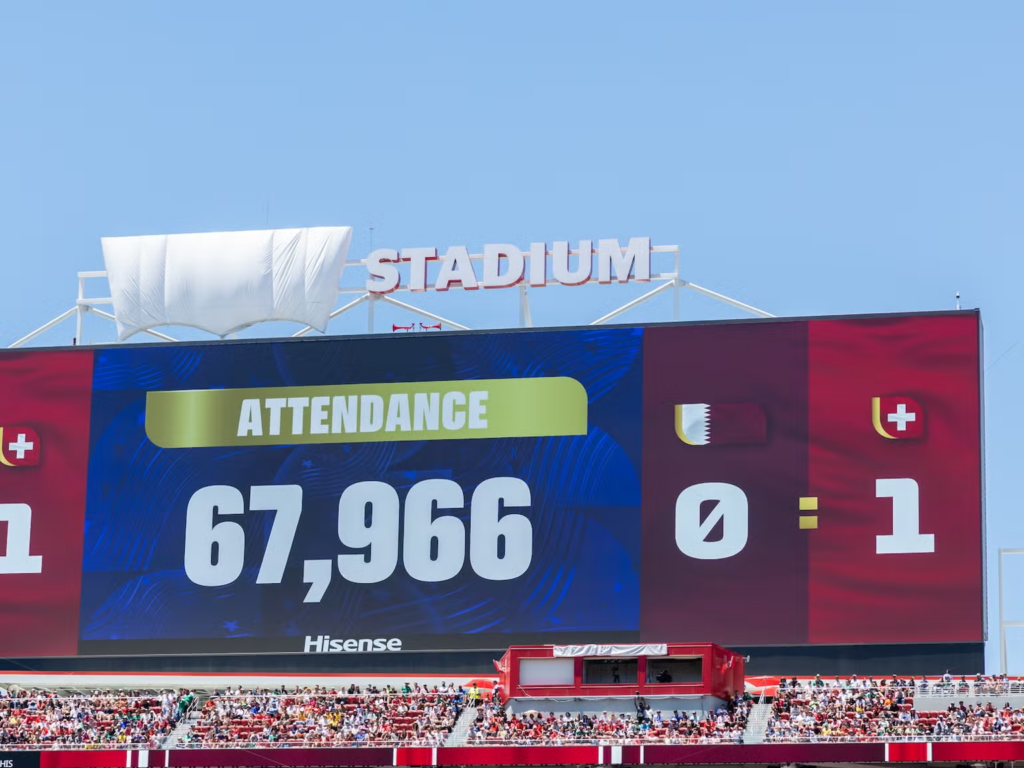
Image: Levi’s Stadium
Levi’s also posted a Reel with the caption: ‘Welcoming the world to the beautiful [redacted] stadium!’ and changed its Instagram profile picture to the tarp image.
In under 24 hours: 700,000 likes on Instagram. On TikTok, a video of the covered logo was set to audio saying ‘Nobody’s going to know. They’re going to know.’ It hit 9 million views.
The StrategiQ takeaway:
Aside from being brilliantly funny, this is a lesson in distinctive brand assets compounding value over time. Years of the Levi’s logo being shown to the world made this possible.
It’s also worth noting that Levi’s holds a 10-year, $170 million naming rights deal for that stadium. FIFA voided the commercial benefit for five weeks. In response, Levi’s generated millions of organic impressions. The score is not even close.
Unilever takes marketing off-pitch with 50,000 creators
As Official Personal Care Sponsor of the FIFA World Cup 2026, Unilever launched its largest-ever sports marketing activation: 35+ brands across 120+ markets, backed by more than 50,000 creators generating social content over the 39 days of the tournament.
The 50,000 creators are athletes and sportscasters, and they span lifestyle, fashion and beauty.
Underpinning it all is ‘The Locker Room’ – a 24/7 social content hub on TikTok and YouTube staffed by creators and community experts who respond and amplify cultural moments in real time.
Meanwhile, House of Fresh™ physical creator hubs have been built in Mexico City, New York and Miami.
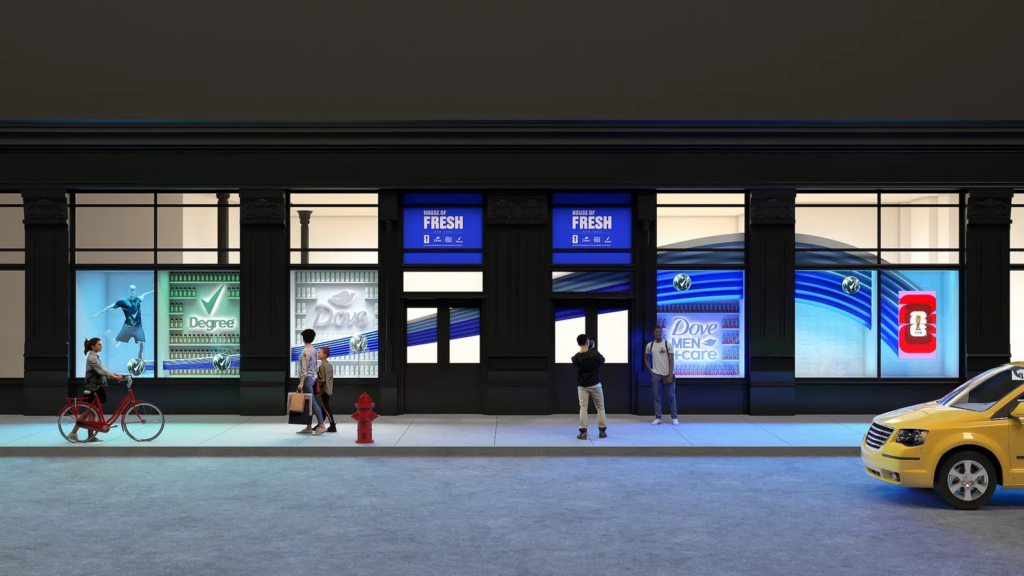
Image: Unilever (House of Fresh)
The StrategiQ takeaway:
Unilever’s ‘many-to-many model’ is the right one. Instead of one brand voice talking to millions, it’s many creators talking to many communities. The whole thing is thousands of steps away from using just one hero concept. Most brands aren’t there yet.
The Locker Room is especially interesting. To man a reactive content ecosystem like this one, responding to games and goals as they happen, you need infrastructure, staffing and editorial judgment around the clock.
Asda leads with experience
Launching 17–27 June and travelling to multiple Asda stores across the UK, ‘Bring It Home’ is a full-scale in-store stadium experience: a players’ tunnel with crowd noise, lighting and live actors, designed to put shoppers in the moment of walking out onto the pitch.
Asda brand partners are in on it, too: Coca-Cola runs a peel-to-reveal game, Lynx hosts a locker room-style fragrance experience, while Budweiser operates a 0% sampling bar.
More than half of UK shoppers plan to get involved in the World Cup, and, for many, that will mean a watch party at home supplied by an immersive Asda run.
The StrategiQ takeaway:
The multi-brand format is worth noting. Since individual brand budgets are being scrutinised more carefully, shared activations let multiple partners create something bigger than any one of them could justify alone.
Adidas transforms the UAE desert into a Rocket League-inspired experience
Ahead of the World Cup, Adidas turned a UAE desert location into a Rocket League-inspired playground that blended football, motorsport and gaming culture.
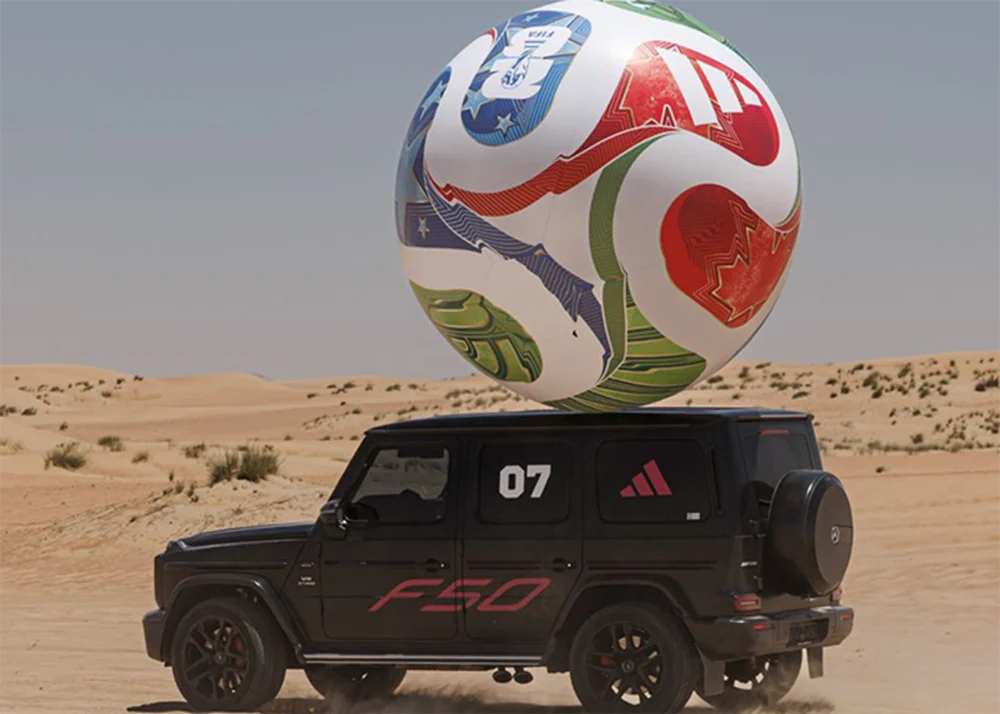
Image: Adidas
At the centre of the activation were customised Mercedes G-Wagons, styled to match the look and feel of Adidas’ latest football boot collections (F50, Predator, Copa).
The vehicles manoeuvred an oversized Trionda football across a purpose-built desert arena.
The stunt brought the video game’s high-speed, car-meets-football aesthetic into a real-world spectacle designed for social-first storytelling.
It’s also worth noting that Adidas is running a separate, star-studded campaign (‘Backyard Legends’ featuring Timothée Chalamet, Lionel Messi, Jude Bellingham, Bad Bunny, David Beckham and others) for the tournament proper. The desert activation is a different audience, a different market, a different register.
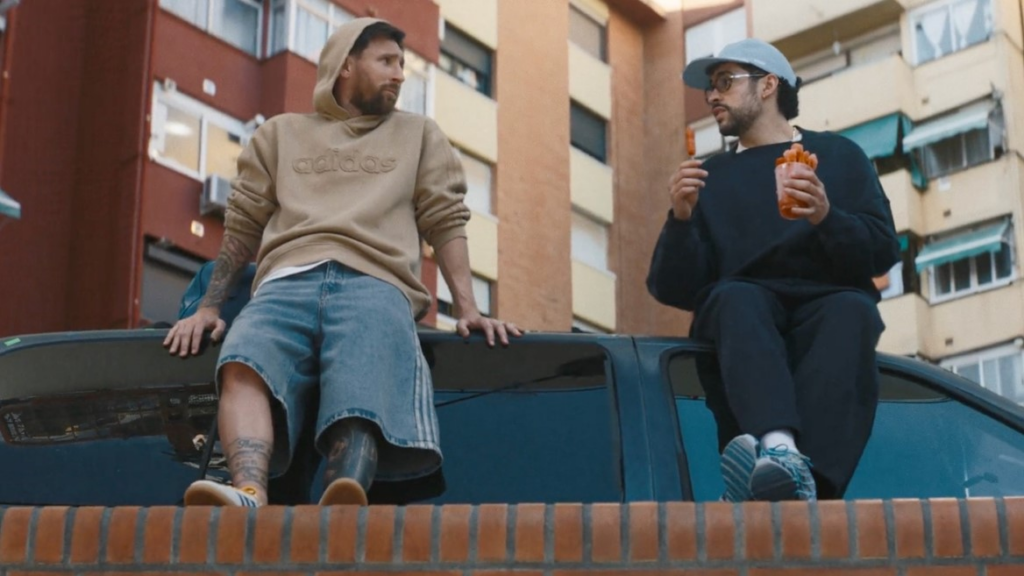
Image: Adidas
The StrategiQ takeaway:
Firstly, customised G-Wagons chasing an oversized football through the desert? Social coverage was practically guaranteed.
Secondly, Adidas recognised that football culture no longer exists in a single lane. For many younger fans, gaming, sport and lifestyle are not separate interests but overlapping identities.
Rather than borrowing aesthetics from gaming, Adidas brought a gaming experience into the physical world, creating something that felt native to all three cultures at once.
Are consumers more sceptical than ever? 69% ditch brands they no longer trust
New research from McCann finds that 69% of consumers say they’ve abandoned brands they no longer trust – while 80% say they’d actively choose brands they do trust.
Tyler Turnbull, Global CEO, McCann said: “Global brands are experiencing a growth crisis as we’ve shifted from a trust economy to a doubt economy, putting CMOs under more pressure than ever. The new playbook for the future of brand building will be grounded in a brand’s ability to show up with clarity, credibility and cultural fluency at every decision point.”
The StrategiQ takeaway:
Consumers aren’t demanding perfection; they’re demanding consistency. As scrutiny increases, trust is earned through repeated proof rather than polished messaging.
Build campaigns around real moments and genuine insights that you can stand behind. Brands that connect to culture in ways that feel authentic to their history, products and audience will be better placed to build trust than those chasing every trending conversation.
As an example, Levi’s response to FIFA’s red-taping controversy generated genuine reactions because it was rooted in a real cultural moment and communicated a clear, understandable point of view. Nothing more, nothing less.
UK under-16s are kicked off social media
On 15 June, Prime Minister Keir Starmer announced that the UK will ban under-16s from using social media platforms including TikTok, Instagram, Snapchat, YouTube, Facebook and X.
The legislation is expected to go before Parliament before Christmas, with protections coming into force in spring 2027. Platforms that fail to exclude underage users face significant fines.
Starmer explicitly said the UK will go further than Australia – which introduced its own ban in December 2025 – with additional restrictions on live streaming and strangers contacting children on gaming platforms. Enforcement action will target platforms, not children. The decision is backed by 9 in 10 parents.
The StrategiQ takeaway:
If any part of your strategy depends on reaching under-16s through TikTok, Instagram or YouTube, 2027 is closer than it looks. So, think ahead.
Gaming platforms Roblox (now launching kid and teen accounts with additional safety settings) and Minecraft are still fair game, as is YouTube Kids.
The StrategiQ takeaway
The through-line this week: the brands scoring points at the World Cup aren’t just the ones with the biggest budgets or the official sponsorship badges. They’re the ones who understood what the occasion means to their audience – and found a way to show up for it as themselves.
In a moment of record-breaking consumer scepticism, that’s the only tactic that compounds. In other words…
Sources:
- https://mccann.com/wp-content/uploads/2026/06/Truth-About-Global-Brands-Executive-Summary.pdf
- https://www.grocerygazette.co.uk/2026/06/15/asda-set-to-launch-multi-brand-in-store-world-cup-activation/
- https://www.unilever.com/news/news-search/2026/inside-unilever-personal-cares-fifa-world-cup-2026-sponsorship/
- https://campaignme.com/adidas-creates-rocket-league-inspired-experience-ahead-of-fifa-world-cup/
- https://www.medianews4u.com/unilever-rolls-out-biggest-ever-fifa-world-cup-activation-across-120-markets/
- https://www.theguardian.com/football/2026/jun/02/pele-no-10-brazil-shirt-1958-world-cup-final-auction
- https://www.newstatesman.com/comment/2026/06/of-course-the-social-media-ban-wont-work-that-doesnt-mean-its-pointless
- https://www.gov.uk/government/news/social-media-to-be-banned-for-under-16s-in-landmark-government-move-to-givekids-their-childhood-back
- https://www.thetimes.com/uk/politics/article/social-media-ban-keir-starmer-under-16s-h73wk6qzj
- https://www.nbcsports.com/nfl/profootballtalk/rumor-mill/news/levis-leans-in-to-absurd-fifa-requirement-that-stadium-names-be-changed