
Welcome to The Uncertain Times. The social platforms have been busy lately! Instagram launched a feature that looks a lot like Snapchat. Snapchat launched an ad format that looks a lot like a chatbot. Meta told parents they can now see what their teenagers are up to. And YouTube pitched itself to advertisers as a TV network with better talent.
So, we figured we’d point out the recent developments and, more helpfully, what it all means for brands.
This week, we unpack:
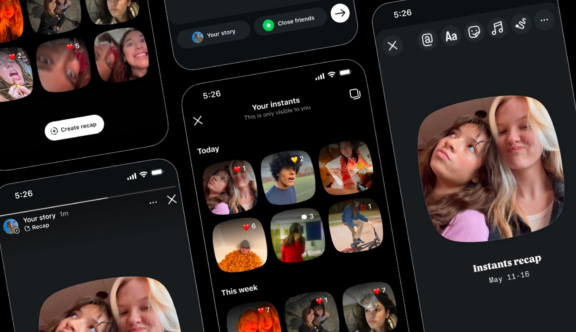
- Instagram rolls out ‘Instants’ – a new means of sharing casual, ‘unfiltered’ and everyday photos with friends
- Snapchat brings about ‘AI Sponsored Snaps’ – so app users can chat to brands’ AI agents
- Meta tightens up, giving parents greater oversight of how their children use its platforms
- Australia’s social media ban means teens see less news than before
- TikTok merges ads, creator content and shopping into one system
- YouTube announces plans to expand its TV-style Creator Shows
Instagram goes ‘Instant’ with disappearing content for close friends
On 13 May 2026, Instagram launched Instants globally – a new feature for sharing unedited, disappearing photos with close friends or mutual followers. Photos can only be viewed once – automatically expiring after 24 hours – and they can’t be edited or uploaded from a camera roll. No filters. No retouching. Just a photo of ‘right now’, sent to people you actually know. Instagram has also released a standalone Instants app in select markets.
The honest read here is that Meta is watching its younger users drift toward more private, less ‘performative’ sharing – and is trying to pull that behaviour back into its own ecosystem before it fully migrates to Snapchat or BeReal.
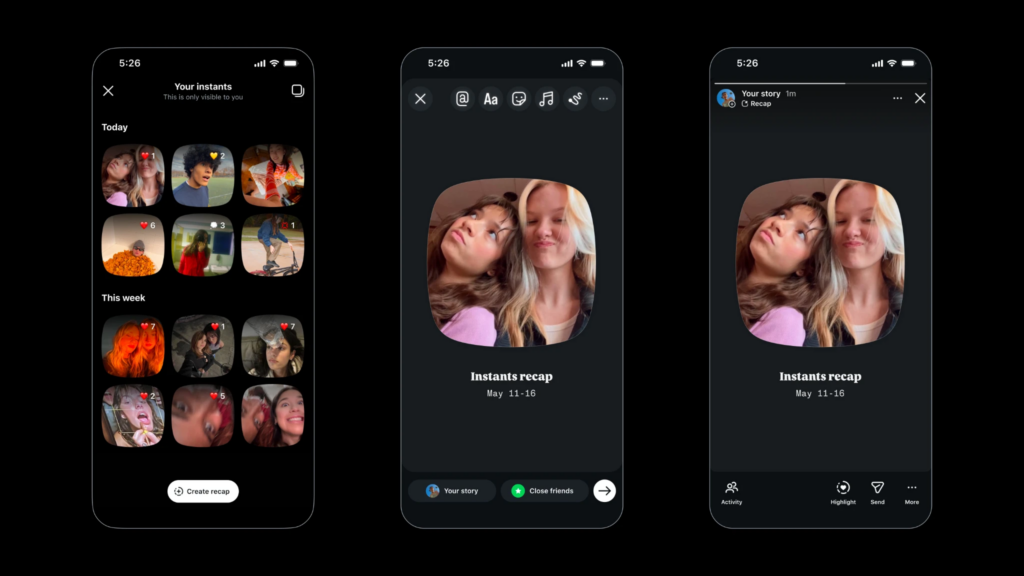
Credit: Instagram
The StrategiQ takeaway: Instants won’t be a channel for brand content – that’s by design. But it tells us something about what today’s users want. The more Instagram pushes authenticity features, the more it signals that highly produced brand content is losing its cut-through. Brands with Instagram strategies based on polished perfection might want to think twice.
Snapchat brings AI-powered conversational advertising to its app
Snapchat has launched AI Sponsored Snaps – a new ad format that places brand-controlled AI agents directly inside the Chat tab, exactly where users message their friends. It means users can tap into a brand’s AI agent and have a conversation.
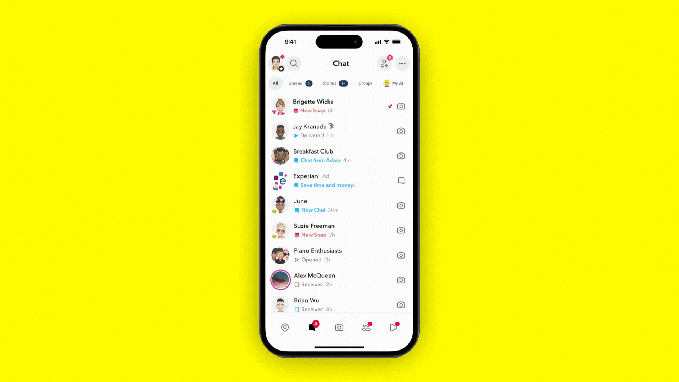
Credit: Snapchat
The first partner is Experian. Snap reports that users sent over 950 billion chats in Q1 2026 alone, and that existing Sponsored Snaps already deliver 22% more conversions at 20% lower cost per action than standard formats.
Snap’s Chief Business Officer Ajit Mohan described ‘conversation’ as becoming; “the most valuable real estate in advertising.”
In theory, it’s a compression of the customer journey into a single interface: discovery, consideration and conversion inside one chat thread, without the user leaving the app.
The StrategiQ takeaway: The risk is obvious: ads that look like messages from friends erode the trust that makes messaging so authentic in the first place. The small grey ‘Ad’ label helps, but it’s a fine line. Tread carefully.
That said, conversational advertising is coming whether the industry is ready for it or not. So, roll-outs like this are worth watching closely.
Meta tightens up, giving parents greater oversight of how their children use its platforms
Meta has launched a consolidated Family Center hub giving parents oversight of their teen’s activity across Instagram, Facebook, Messenger and Meta Horizon from a single dashboard.
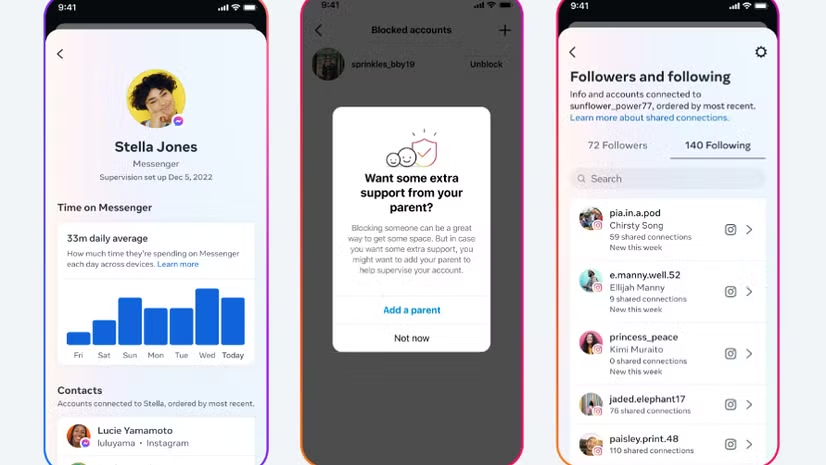
Credit: Meta
New features include visibility into the general topics that shape a teen’s Instagram algorithm, with notifications coming when teens add new interest categories. Meta is also rolling out AI-powered age checks using visual cues, and has introduced topic-level summaries of what teens are discussing with Meta AI – without revealing full chat transcripts. This follows a landmark court ruling in New Mexico that found Meta legally liable for endangering child safety.
Meta is under huge legal, regulatory and reputational pressure. These features are its attempt to respond. Although independent analysis suggests a gap exists between having the controls and parents actually using them.
An interesting question is what this signals about the future of teen audiences on Meta platforms. Stricter controls may keep regulators happier – but will teens put up with their parents monitoring their interests? Or will they exit the platforms?
The StrategiQ takeaway: Between teens being banned from social media around the globe (more on that below) and new features like these… all roads point to stricter regulation. It’s a strange time to be marketing to younger audiences via social media. If advertising to teens is a part of your brand strategy, now could be time to consider how this delivers ROI.
Australia’s social media ban means teens are seeing less news than before
Australia’s world-first under-16 social media ban came into effect in December 2025, with platforms required to take steps to prevent underage accounts. New research published this week finds that among the teens most affected by the ban, 51% report getting less news as a direct result.
Rather than finding alternative sources, the evidence suggests many young people are simply disengaging from news altogether. The ban’s reach has been limited so far – 61% of under-16s report little or no change in social media use, with many bypassing the restrictions via VPNs or older siblings’ accounts.
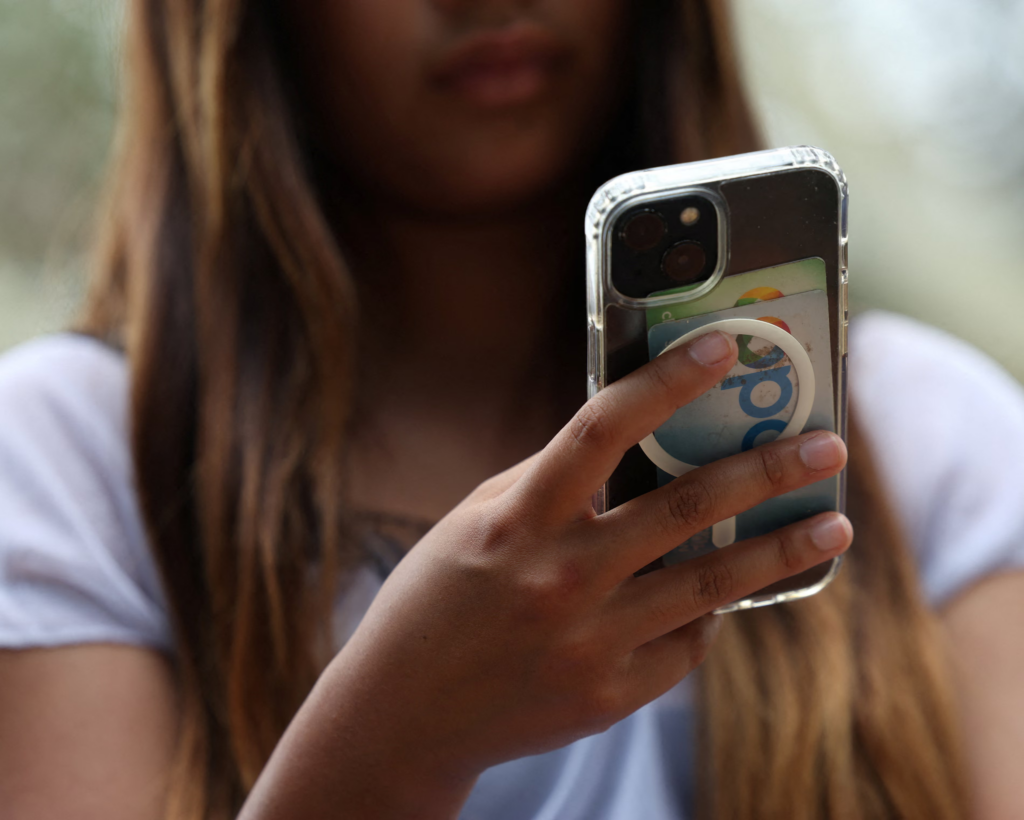
Credit: Hollie Adams/Reuters
The Australian experiment is providing data for every government currently considering similar legislation – the UK included, where debate continues. The headline finding about news consumption shows that banning social media for under-16s doesn’t redirect young people to healthier sources. For a generation that grew up using social media as its news discovery channel, it simply means removing their primary news source.
The StrategiQ takeaway: It’s often the way with policy change: it inconveniences, but it doesn’t alter behaviour. The government raises cigarette tax, yet people still smoke. Creating healthier habits doesn’t happen overnight (or as soon as you change the rules). Something for brands to remember when ideating campaigns.
TikTok just made its biggest move yet to become a shopping platform
At TikTok World 2026 in New York, the company unveiled a series of new ad tools designed to turn TikTok from a place where people discover products into one where they actively search for, compare and buy them too:
- Search Hubs: branded pages that appear at the top of TikTok search results, giving brands a kind of mini storefront inside the app.
- Branded Buzz: a tool that allows brands to invite large numbers of creators to submit campaign content at scale, making influencer campaigns faster and easier to run.
- Keyword Amplifier: which links creator videos to TikTok search recommendations through clickable comments.
TikTok also expanded its Symphony AI suite with new video and image generation tools, and quietly launched what may be the most important update of all: an Ads MCP Server, which allows third-party AI tools to directly manage TikTok ad campaigns.
The direction the app’s travelling in? TikTok as a full commerce ecosystem.
For years, TikTok has dominated the ‘discovery’ part of the internet – the place where trends begin and products go viral. But now it wants to own what happens next too. Search Hubs are the clearest signal of that shift. TikTok knows users increasingly treat the platform like a search engine, especially younger audiences searching for restaurants, beauty products, travel ideas and reviews. Nearly half of consumers already use TikTok to search for products and inspiration. The company is now building the infrastructure to monetise that intent at the exact moment it appears.
In many ways, this is TikTok moving onto Google’s turf.
But the bigger story may actually be automation.
The launch of TikTok’s Ads MCP Server suggests a future where AI tools can plan, launch and optimise campaigns with minimal human involvement. That could greatly reduce the operational effort required to run TikTok advertising.
At the same time, TikTok is doubling down on creator-led commerce. Branded Buzz essentially turns creator sourcing into a scalable system, allowing brands to brief hundreds of creators at once instead of negotiating partnerships one-by-one. The result is likely to be more ads that look and feel like organic TikToks – and a platform that becomes increasingly shoppable by design.
The StrategiQ takeaway: Is TikTok about to feel less like a social platform and more like a personalised shopping channel? The app is betting on convenience outweighing everything else, as dance videos and the likes make way for search infrastructure, in-app shopping and AI-powered advertising.
YouTube wants creators to become the new television networks
At Brandcast 2026 – YouTube’s annual pitch to advertisers held this year at New York’s Lincoln Center – the platform unveiled a major expansion of its new Creator Shows format: professionally produced, seasonal series fronted by YouTubers rather than traditional studios or broadcasters.
Think less one-off YouTube uploads, more Netflix-style programming built around creators.
Credit: YouTube Blog
Alongside the new shows, YouTube also introduced:
- Custom Sponsorships – AI-powered product placements that allow brands to appear more naturally inside creator content.
- Buy with Google Pay – a new two-click checkout system for connected TVs, meaning viewers can buy products directly from their television screen without reaching for their phone.
- New AI-powered creation tools built on Gemini, Veo and Nano Banana, designed to help creators generate video, visuals and production assets faster.
YouTube also shared new data showing viewers are 13x more likely to search for a brand and 5x more likely to purchase after hearing a creator mention it.
The StrategiQ takeaway: YouTube isn’t just after brands’ digital ad spend – it’s coming directly for television budgets. It’s packaging creator content in a way that increasingly resembles traditional TV programming, while combining entertainment, recommendation and checkout into a single ecosystem.
The StrategiQ takeaway
The thread running through everything happening in Social right now is that the platforms are looking to become the entire customer journey themselves.
Whether it’s TikTok building search infrastructure and AI-managed commerce, YouTube turning creator content into shoppable television or Snapchat experimenting with sponsored AI conversations, the direction of travel is clear: platforms are trying to keep discovery, consideration, engagement and purchase contained within their own ecosystems for as long as possible.
Brands need to act with this in mind, to avoid competing in unwinnable shouting matches. Because, consumers are tuning out excess noise and gravitating towards creators, communities and conversations that feel authentic, useful or entertaining. In many cases, they’re choosing to interact with brands on their terms, within the platforms and formats they already trust.
StrategiQ helps brands navigate a Social landscape that’s changing faster than ever. Because…
Sources: