

Our Head of CX, Nat McHale, hosted a room of senior marketers and CX leaders at our Shoreditch office to tackle one question: what does brilliant CX actually look like from here?
“The evening reminded me why I chose this specialism. The discussion ranged well beyond CRM and CX into paid media, offline activation, SEO vs GEO – and that’s exactly the point. It’s a reminder that CX isn’t a silo. The best CX professionals understand the whole business, and think about CX as a strategic layer that runs across every part of it.” – Nat McHale
The event
To get the room thinking, we handed attendees a printed copy of CX Chronicles – a retrospective look back on the present times from an imagined 2029, written to provoke debate rather than predict the future with certainty.
It made some bold bets: first-party data as the real moat, agentic AI moving from buzzword to infrastructure, Customer Effort Score finally getting its due.
Whether or not every number holds up by then, it did exactly what it was designed to do – it got a room full of senior CX leaders to think about how what they do now will play out in the next three years.
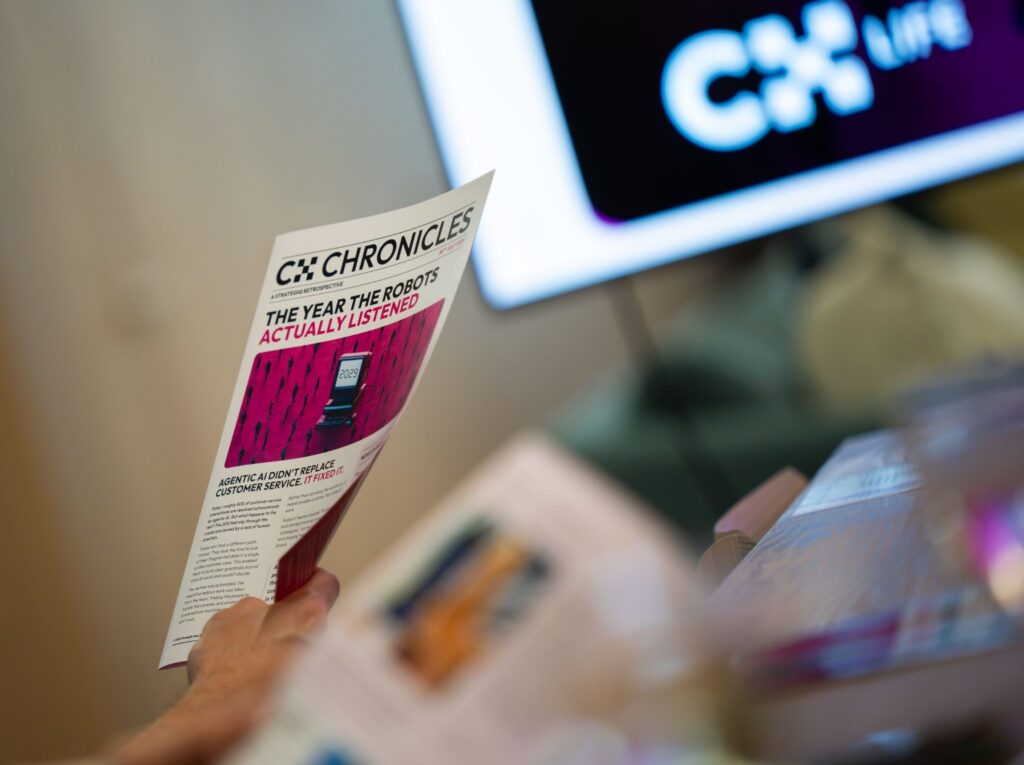
Our 2029 CX ‘headlines’
Three predictions that framed the room’s thinking:
- First-party data won. 70% of ad spend now runs on owned data.
- Effort Score beat NPS. Companies focused on Customer Effort Score saw 89% retention. Those chasing NPS alone saw just 33%.
- Privacy paid off. GDPR fines have exceeded €7.1 billion. Brands that embraced consent-first design and invested in a CDP came out ahead; everyone else got caught out.
Fuelled with this material, here’s what the room agreed on once the debate got going.

5 takeaways
AI handles scale. Humans handle stakes.
AI is great at managing routine interactions – really great, in fact. The repetitive, high-volume tasks that used to eat into the day. But the moment a conversation turns emotional or high-stakes, people are essential.
Our imagined 2029 pushed this further: it suggested that even once 80% of service interactions get resolved autonomously, the remaining 20% won’t shrink because the technology’s still catching up.
The brands that got this right in 2029, per the exercise, built clear guardrails around what AI could and couldn’t decide, then freed up their teams to spend real time on the conversations that needed – and always will – a person.
Automation made room for better human work, it was never a replacement for it.
Data strategy before automation
Before building unified customer profiles or investing in more tech, brands need to get honest about what signals they need and why. Disconnected data and unclear ownership are still the biggest blockers standing in the way – no automation strategy fixes a data problem underneath it.
CX Chronicles’ framing was blunt on this point: a CDP is a tool, not a strategy. The gap between “we have a CDP” and “we truly own our customer data” is where most transformation budgets quietly slip off a cliff. It’s a distinction that shows up in our client work too – we’re rarely just implementing a platform like Klaviyo, Dotdigital or HubSpot. The real work is the operating model underneath it: auditing where data’s scattered, designing consent flows properly and making sure teams can use the platform.

Trust is fragile
The room was candid about the ‘creep factor’ around dynamic pricing and location-based targeting. Overreach here does long-term damage to a brand – the kind that’s very hard to earn back once trust is broken.
The 2029 exercise played up this, tying it to a chilling €7.1 billion GDPR figure. Privacy, in that telling, was something many brands had got wrong.
Zero-party data – the stuff customers volunteer directly, because they trust you enough to share it – was pitched as one of the fastest-growing and most valuable data sources because it can’t be scraped or inferred. Trust, in many ways, is a data strategy and a road to tread with care.
CX measurement needs a rethink
NPS, CSAT and CES each tell you something different about the customer journey. Leaning on just one will only ever give you part of the picture.
This is where the room leaned hardest into the printout’s numbers – Effort Score’s 89% retention figure against NPS’s 33% got people talking. But the more interesting provocation was the idea of a ‘metric stack’ rather than a single favourite score: measuring NPS, CSAT and CES together, rather than picking one champion metric to report on.
However this shakes out, it’s a useful discipline – the brands measuring well are the ones triangulating from multiple angles.
Physical isn’t dead
Direct mail, pop-ups and in-person brand moments all still cut through digital noise. Sometimes more effectively than another email ever could.
Fittingly, the room agreed on this one over a printed handout and a glass of wine. Our brand book was also catching eyes at the event.



We talked, we laughed, we nibbled, we made some bold predictions; a CX-filled night as it should be done.
A huge thank you to everyone who came, shared and challenged the room. Watch this space for the next CX Life LIVE.
Get in touch about CX strategy