

Day 2 of MAD//Fest and we’re back – slightly less fresh than yesterday, significantly more opinionated.
If Day 1 was about the industry confronting uncomfortable truths, Day 2 got practical. The sessions moved from diagnosis to prescription – frameworks, playbooks and proof points from the brands actually doing the work.
The team spread across the stages. Here’s what they came back with.
Key takeaways from day two:
- The path of desire isn’t a straight line – AI has killed the funnel
- AI recommends brands that actually help people
- Make something worth remixing – when to use AI according to Lego
- Creativity needs structure – how Trinny London built a business around it
- The science of standing out – lessons from behavioural science
- Fred’s day 2 dispatch
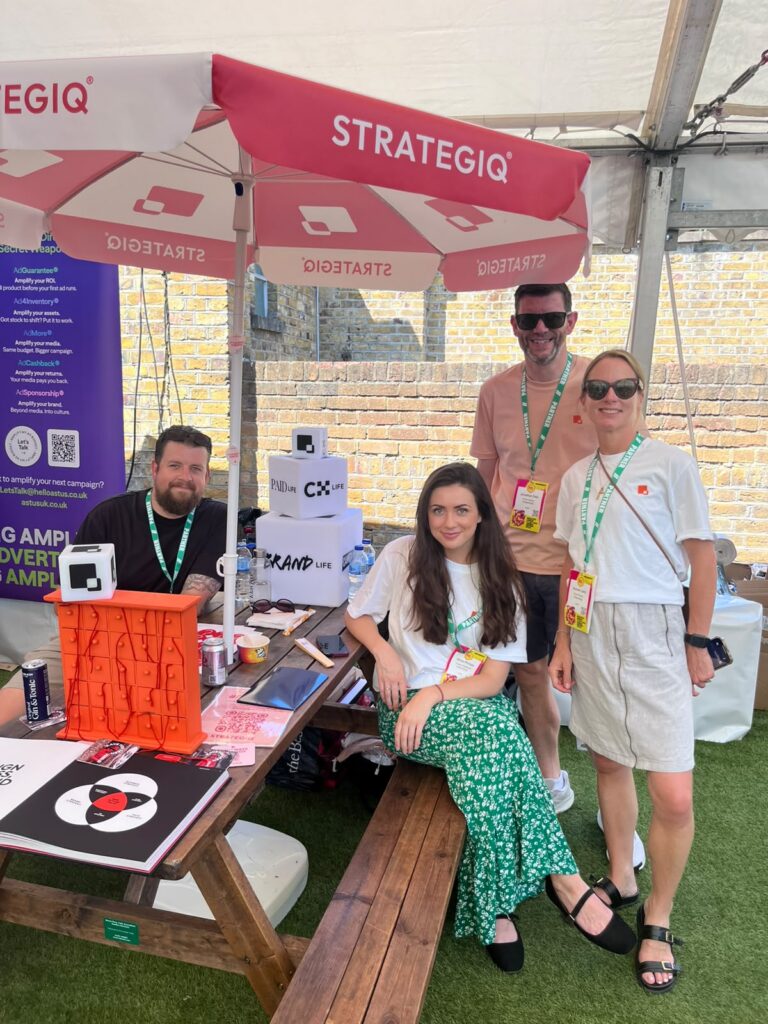
1: The path of desire isn’t a straight line
Havas CX brought together Claire MacArthur (Studio MacArthur), Ben Richards (LEGO Group) and David Shulman ( Global CEO, Havas CX, Havas) for one of the more unexpected combinations of the day – and one of the most useful.
The thread connecting all three: the best experiences are designed around what people actually need, which is almost always different from what they say they want.
The central idea: brands claim to be customer-centric, but the stronger move is following the customer’s actual desire line – the path they naturally want to take – rather than the one the brand has designed for its own convenience. The difference sounds subtle. The results aren’t.
Claire’s framing came from landscape design but landed squarely in agency territory. Clients come with an idea. That’s never where you end up. “The first idea is not what we land on after we’ve told stories. We are there to solve the real problem.”
Her broader point extended this further: great brands don’t just respond to customer needs, they help customers see new possibilities they couldn’t have articulated themselves. Whether in landscapes, soil or wheat, perceptions of value and ‘premium’ can be reshaped through education and experience.
“Clients want an experience, they want a journey… create a journey that they want to nurture.”
Ben Richards brought LEGO’s philosophy to the same idea. “Customer metrics drive the business, not the financial results.” Craft led, not tool led. And an execution obsession that runs through everything – including hiding Easter eggs in LEGO sets for the fans devoted enough to spot them. Most people never will. The ones who do feel something you can’t manufacture.
The StrategiQ takeaway: The real problem is rarely the stated problem. The brands that last are the ones willing to go past the brief, past the first idea, past what the customer says they want – until they find what they actually need. Most brands optimise for the average. The ones that last reward the devoted.
2. AI recommends brands that actually help people
Naomi Walkland, CMO at Motorway and Neil Barrie, Co-founder and CEO of 21st Century Brand, opened with a provocation that the rest of the session made good on: the traditional marketing funnel is dead. And AI killed it.
Rather than moving customers through stages, LLMs form a view about your brand from everything they’ve ever read about you, then decide whether to recommend you before the customer has even started looking. The question changes from “how do we move people through the funnel?” to “how do we earn the right to be recommended before they’re even in market?”
Their framework: four things brands need to get right.
- Coherence – a clear, consistent reason to choose you.
- Currency – understanding what’s important to your customers and driving relevance through creators and partners.
- Authority – third-party endorsement from voices AI models trust.
- Advocacy – experiences so good people recommend them without being asked. AKA Reddit.
Two lines worth keeping: “The best brands don’t win just on content, they win on having the proof points as well.” And the starting point: “What is AI saying about your business? Take that back as evidence.”
Critically, this isn’t just a marketing strategy but a business one. AI recommendations are shaped by everything – product, experience, community, press. “Marketing is at the intersection of everything” – which means the whole business needs shared accountability, not just the marketing team.
The StrategiQ takeaway: The shift from “how do we reach customers” to “how do we earn AI recommendation” requires the same thing great brand strategy has always required: clarity, consistency and proof points that hold up under scrutiny. It’s about building something genuinely worth recommending. It’s about helping people. That’s always been the brief, it’s just more measurable now.
3: Make something worth remixing
Ben Richards (Global Head of Experience, OLA, The LEGO Group) and Rebecca Rowntree (AI Creative Technologist and Creative Director, GSD Studio) delivered the session that cut through cleanest on Day 2.
LEGO’s position is simple and they’ve never wavered from it: “Not AI first. Human first.” And “We are a craft-forward business.”
The proof point is their World Cup ad – 900 million views, a Cannes Lion and a deliberate #NoAI tag in the creative. No generative imagery. No AI shortcuts. Just craft, made to the standard LEGO holds everything to.
Then something interesting happened. The same team used AI to amplify and distribute it. The ad was intentionally AI-memed. People were prompted to remake it in their own style, essentially handed an instruction manual for remixing. The result was distribution that a media budget alone couldn’t have bought. Consumers acting as DJs, taking the original and producing their own versions – each one extending the reach.
The lesson isn’t that AI is good or bad. It’s that the sequence matters. Lead with the human. Use AI to multiply.
“When you put something out into the world, prepare for it to be remixed and embrace it. Listen, look, see what’s happening and get better at it.” – Ben Richards.
Rebecca’s framing was the most quotable of the session: “The toolbox is so much bigger now.”
Nobody wants to remix slop or remake something that wasn’t worth making in the first place.
“Creativity is still at the heart. Craft is still at the heart.” AI changes the scale of distribution, not what’s worth distributing.
The StrategiQ takeaway: The LEGO World Cup ad is one of the clearest answers to the AI creativity debate we’ve heard. Make something genuinely worth making. Then use every tool available to get it seen. The mistake most brands are making is using it to generate ideas rather than to amplify the good ones. Consumers can tell the difference. They remix the things worth remixing and scroll past everything else. Lead with craft. Let AI do the heavy lifting after.
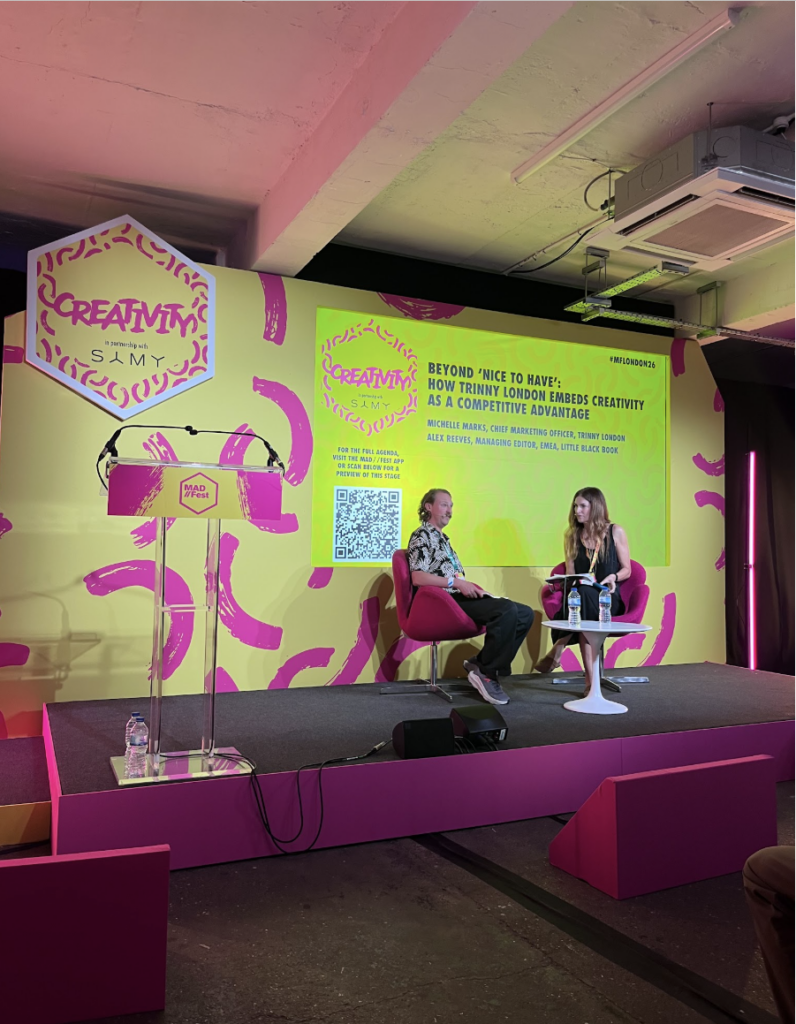
4: Creativity needs structure – how Trinny London built a business around it
Michelle Marks (CMO, Trinny London) and Alex Reeves (Managing Editor EMEA, Little Black Book) made a case that creativity isn’t a department or a budget line. It’s an operating model.
Trinny London starts with an advantage most brands would pay for: a founder whose creative DNA runs through everything. But Michelle was clear that a creative founder is a foundation, not a system. Her job is to build the structure that lets creativity thrive at pace and at volume, without the founder becoming the bottleneck.
The model is deliberately flat. Ideas come from everyone. Working at pace and volume takes the pressure off any single idea, which lets people relax enough to actually be creative.
That became a principle: your first idea is your pilot idea. If it doesn’t work, you’ve learnt something. Don’t be afraid of it because it’s a benchmark for what comes next.
Trinny London’s 190,000-strong community (the Trinny Tribe) acts as a live creative focus group. Real reactions and real opinions route creative decisions before they’re committed to. A feedback loop built into the operating model.
“AI and dashboards tell you what’s possible. The human behind that has the gut feeling that decides what feels right for the brand.”
The StrategiQ takeaway: The pilot idea principle is worth borrowing. Your first concept can just be the starting point. And the Trinny London model shows that creativity is structural. Build the conditions and the ideas follow.
5: The science of standing out – lessons from behavioural science
Richard Shotton, author of The Choice Factory and founder of Astroten came with three ideas worth noting.
Rituals create value. The Guinness pour is a persuasion strategy. Research by Norton et al (2013) found a 16% uplift in taste scores for chocolate bars when respondents were told to eat them in a specific way. Oreo’s twist, lick, dunk. Cadbury’s “how do you eat yours?” The ritual makes the product feel more valuable. It also taps into social proof – if something looks considered and deliberate, more people want it.
Distinctiveness compounds. Apple’s white earbuds stood out when every other pair was black. Monzo’s hot coral card is visible every time it’s used – free advertising in the moments that matter most. Standing becomes a commercial strategy.
“Good things come to those who wait” is one of the greatest ads ever made and it was made by ignoring the brief. The client instructed the agency not to mention the time it takes to pour a Guinness. The creatives ignored that and built the entire campaign around the wait. To huge success.
And one more: the Pratfall effect. Admitting a flaw makes you more relatable and likeable. Bonnet et al (2003) found that acknowledging a weakness increases trust, because nobody believes a brand with no flaws. Honesty is a competitive advantage most brands are too nervous to use.
The StrategiQ takeaway: Rituals, distinctiveness, waiting, honesty. The instinct to hide a flaw or smooth over a friction point can be counterintuitive. The rough edges are frequently where the value is.
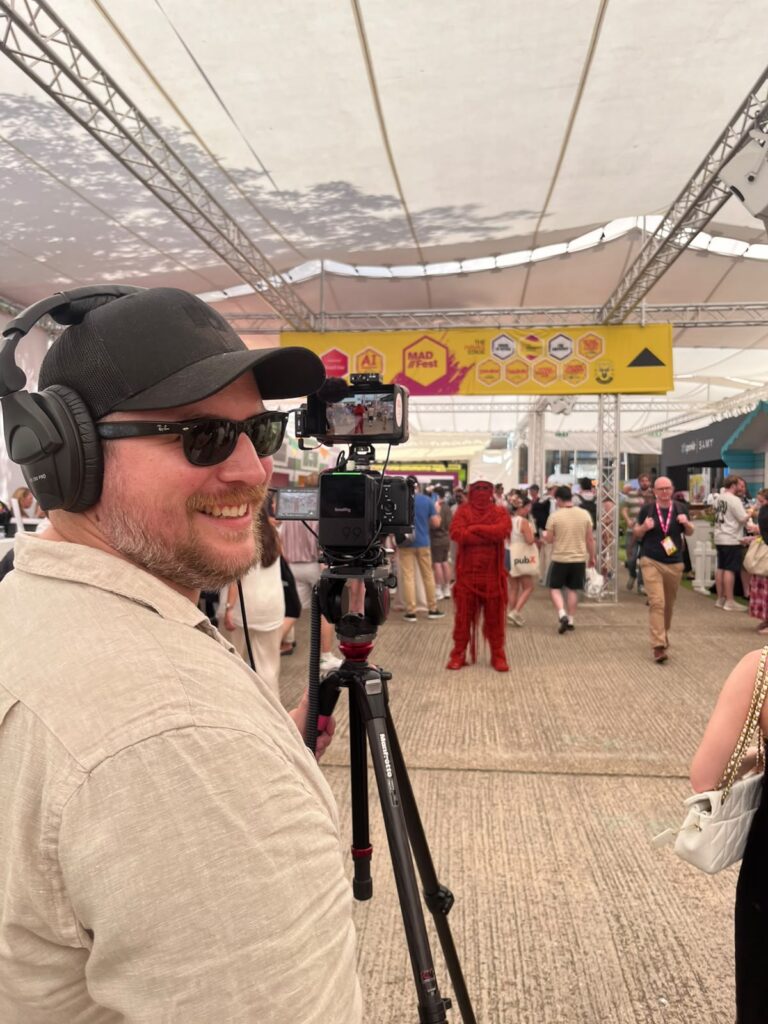
6. Fred’s day 2 dispatch
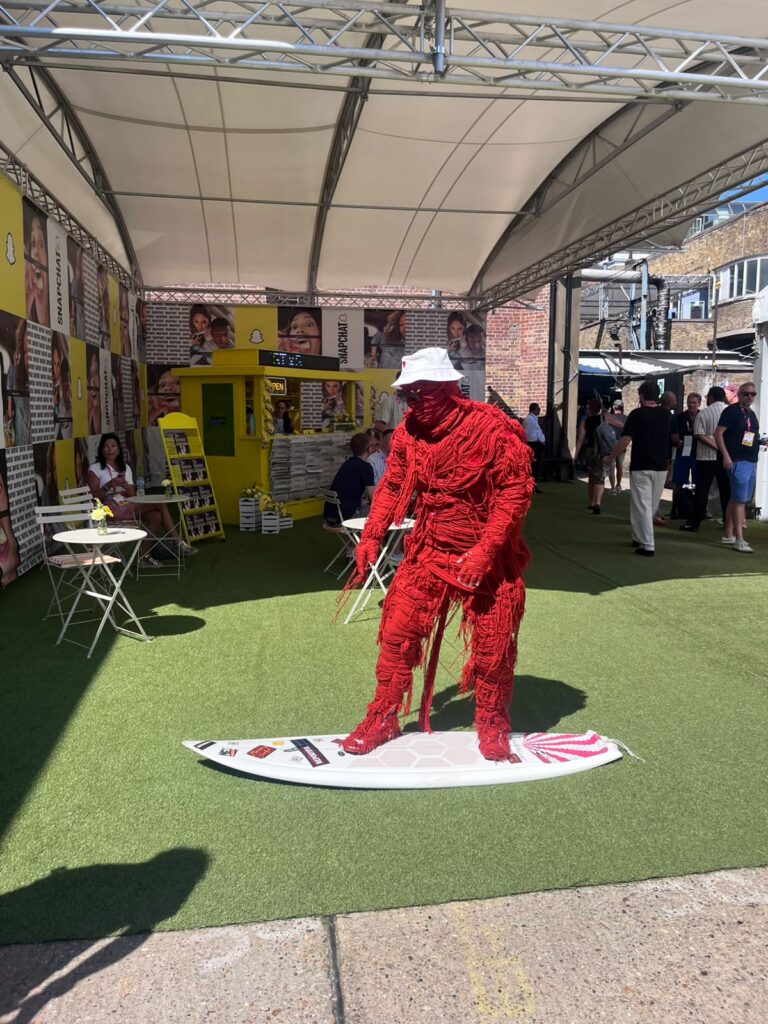
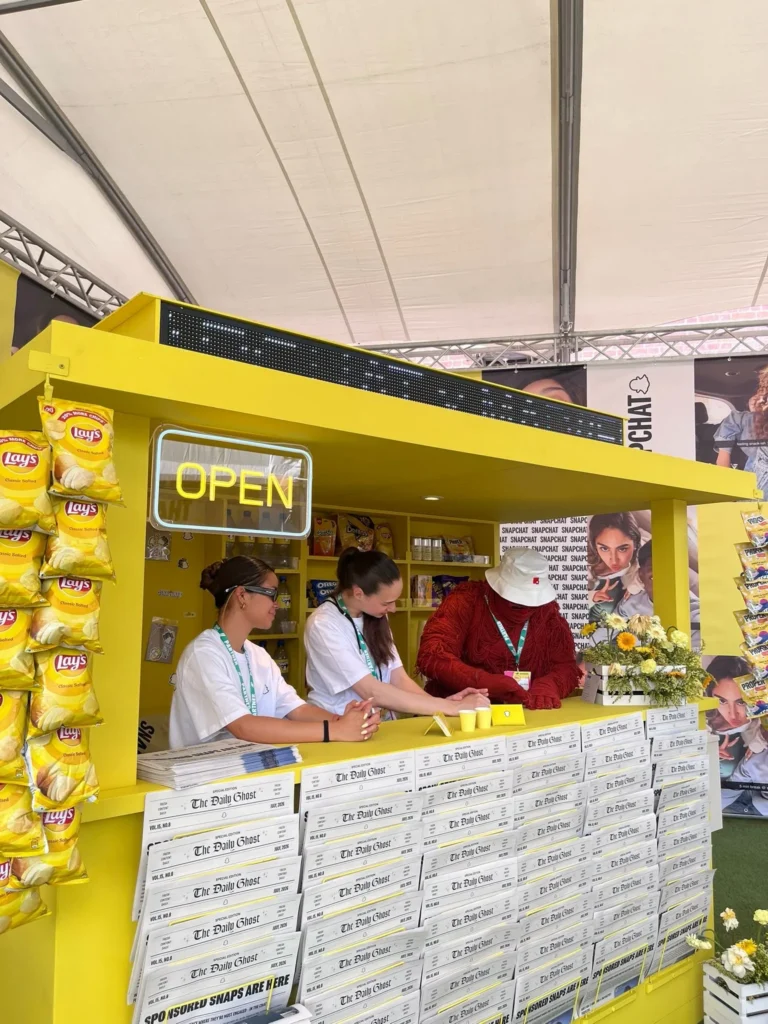
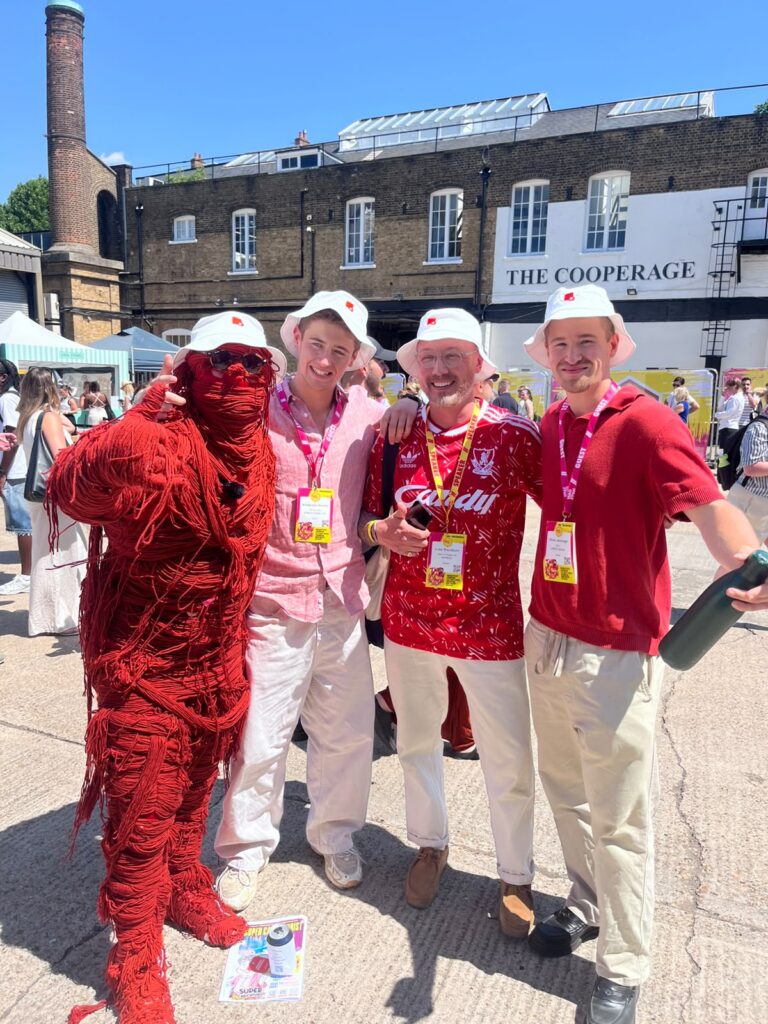
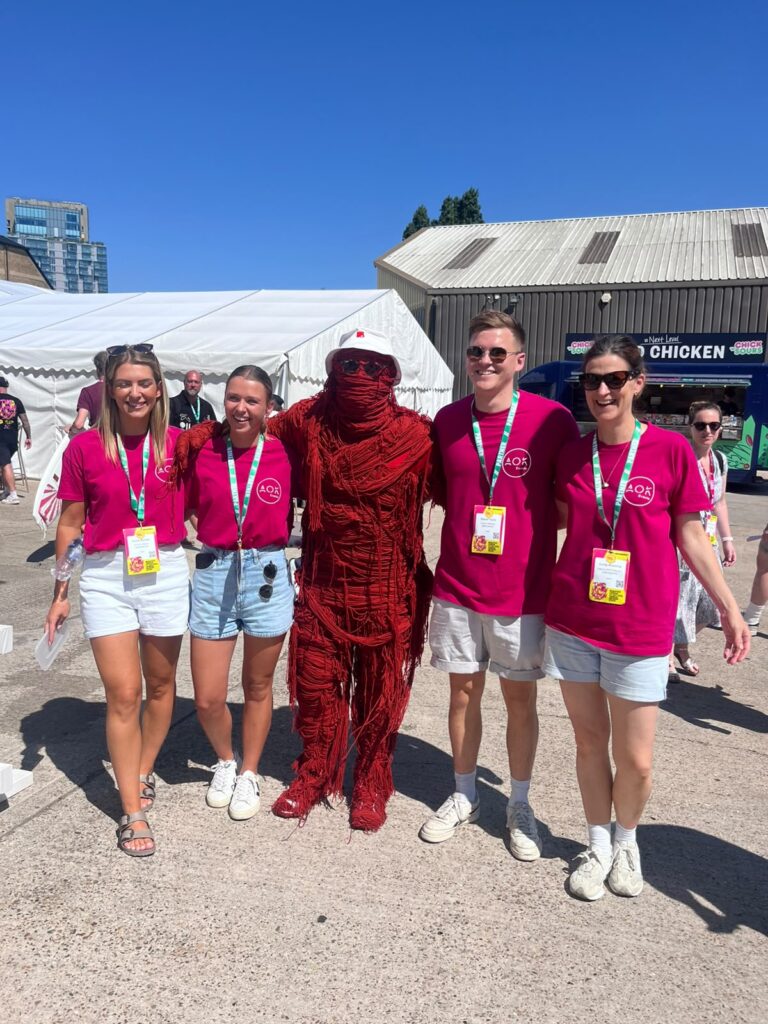
While the team was inside absorbing frameworks and sharing insights, Fred was out in the world doing what Fred does – showing up where nobody expected him and making sure nobody forgot the thread.
In 48 hours, he has:
- Become an honorary barista at Flat White or F**k Off
- Ridden a Lime Bike through Shoreditch without losing a single piece of thread
- Breakdanced at MAD//Fest in front of a crowd that absolutely did not expect it
- Been interviewed by Bluestripe Group – apparently they had questions
- Visited Snapchat HQ
- Graffiti’d a wall
- Attended talks and asked no questions
The reaction? Mainly people asking if he’s too warm in there.
Fred isn’t just a mascot. He’s the Orange Thread made physical – the idea that the brief never ends, that the connecting idea runs through everything, from the first strategic conversation to the last line of code. At a festival themed around The Human Touch, a figure literally woven together from a single thread feels appropriate.
Want to know more about what Fred stands for?
Sources: