

Seven of us headed to BrightonSEO this week, scattered across sessions on GEO, E-E-A-T, content strategy and AI search. Brighton in October means a cold sea, a long agenda and at least one lunchtime dip to reset before the afternoon.
From how AI agents decide which brands to recommend, to the missing human ingredient that no LLM can replicate, here’s what mattered.
Key takeaways:
- SEO can’t stay in its lane. GEO makes search a broader business function – it only works when SEO is integrated with PR, content, social, product and brand.
- Getting crawled is no longer enough – AI needs to understand you. You need to give it consistent, credible evidence of who you are across every channel it can reach.
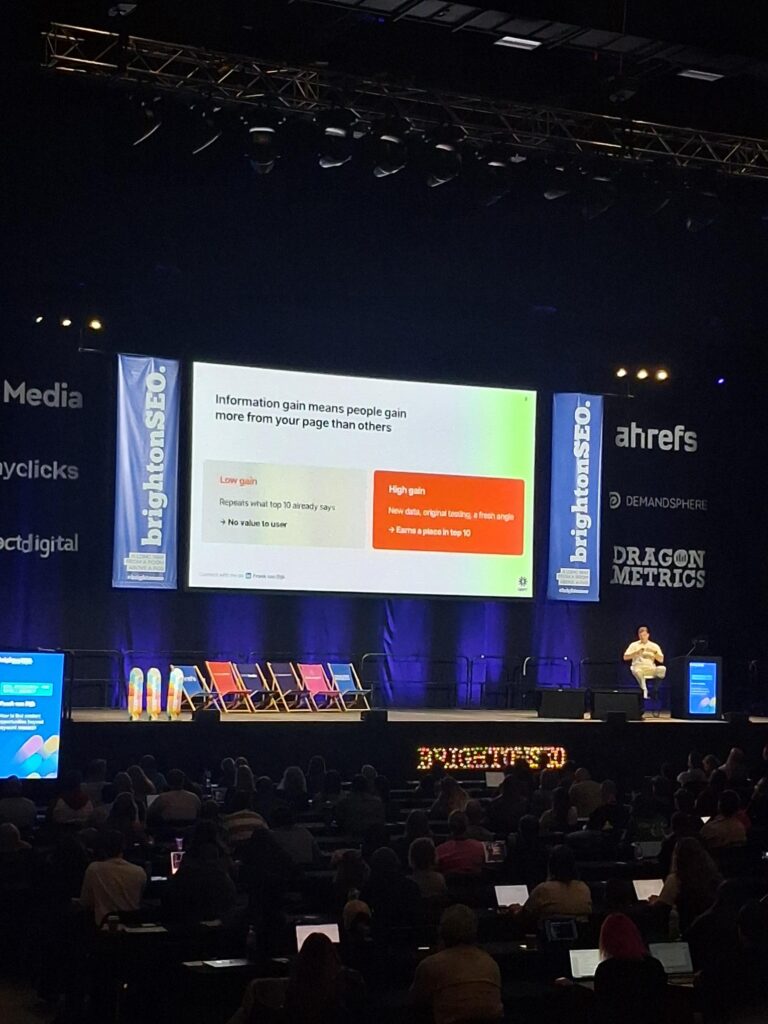
- AI is a truffle hunter. Most content is slop. Information gain – how much new, useful knowledge your content adds beyond what already exists – is fast becoming the metric that determines what gets cited.
- Empathy is the missing E in E-E-A-T, and it’s the one LLMs can’t replicate.
- AI is making the basic SEO audit table stakes. The value is now in strategic prioritisation and commercial judgement – showing clients where to put their attention rather than producing another report.
- It starts with the prompt, aka the customer, and what matters to them. The tools are pretty irrelevant if you’re not starting here. Only this way can you give AI something worth finding.
- A cold lunchtime dip in the sea is the pick me up you need after lunch.

1. GEO is making search everyone’s problem
The most significant shift Day 1 surfaced was structural.
In Jean Dejsuvan‘s GEO session (MG OMD), the question she put to the room was blunt: if you removed your website from the internet today, does AI still have enough information to describe your brand accurately? If the honest answer is no, that’s not a problem the SEO team can solve alone.
The signals AI agents use to recommend a brand aren’t confined to the website. They come from PR coverage, forum conversations, reviews, social presence, affiliate content – the full ecosystem of things people and AI can find about you. A well-optimised site still won’t overcome poor products, negative sentiment or evidence of unhappy customers.
“The tactics of SEO and GEO are actually still similar, and everyone is trying to find the best way to tie measurement and attention to visibility. It’s still vital to make sure that your site can be accessed correctly by search and AI bots, but it’s just as important to ensure that they can properly understand the brand too.” – Mat Davis, SEO/GEO Strategist, StrategiQ
Mat’s StrategiQ Takeaway: This makes search a broader business function, with a greater focus on brand and product, rather than a siloed marketing or performance channel.
If success in search now depends on brand sentiment, product quality and earned media as much as on technical work, then SEO has a seat at a much bigger table. The team that used to live in Search Console needs to be the team making the case for integrated strategy in the boardroom.

2. AI wants truffles. Most content is slop.
Information gain came up in three separate sessions on Day 1 alone. Different speakers, in different rooms, making similar points.
The concept, rooted in a Google patent from 2018, scores how much new and useful information a piece of content adds beyond what already exists. Paris Childress from Hop AI has been testing it in practice, running case studies with measurable lifts in AI citation share.
“AI mostly feeds at the trough of AI slop, and it’s happy to do so. But we can all do much better. What it wants is truffles – something exceptional that is useful. AI is really a truffle hunter. Information gain are the truffles. Help AI find your brand’s truffles.” – Paraphrased from Paris Childress, CEO, Hop AI
But how much of your “secret sauce” are you willing to share? Paris acknowledged that while publishing your most proprietary knowledge makes you more citable, it also exposes your thinking to competitors.
Frank van Dijk approached the same problem from a discovery angle: where do the truffles come from? Reddit and YouTube, he argued, are where trends appear before search volume exists. The signal is velocity. A spike in community mentions can indicate something brewing before any keyword data reflects it. Publish when mentions are rising and you get a first-mover advantage that’s hard to recover once the trend peaks.
Christian Rigg from Eleven Writing gave the most practical answer: the truffles are already inside your business. They’re in your sales calls, your Slack conversations, your client meetings, your internal experts. The system he described captures thought leadership from across the organisation – pulling from meeting transcripts, internal tools and expert interviews into a structured knowledge base – then uses that as the grounding layer for content briefs. It’s the infrastructure that makes information gain achievable at scale.
The StrategiQ takeaway: The gap between generic AI-generated content and content with genuine information gain is going to widen fast. Brands investing in capturing real expertise from their teams, clients and customers will be cited, ranked and recommended more. Start with your own business. That’s where the truffles are.
3. Empathy is the missing E and LLMs can’t provide it
The session that sat with us longest was Katie Mishner’s (NOVOS).
Her argument: E-E-A-T is missing an E. Empathy – being sensitive to the feelings, thoughts and lived experience of another person – is the ingredient that no LLM can replicate. AI can synthesise vast volumes of information, recognise patterns and retrieve them at scale. What it can’t do is feel the stakes of a decision. It can’t know what it’s like to buy running shoes with narrow feet, or to be a first-time investor who doesn’t want to look stupid, or to be a parent researching a diagnosis at midnight.
Search queries are getting more specific and contextual – “washing machine” has become “washing machine good for dog hair in a small space.” AI assistance is now chosen almost as frequently as asking friends and family. “Intent means more than ‘commercial or informational’,” Katie told the room. The person behind the query matters more than the query type.
Katie’s framework for building empathy into SEO strategy was one of the most actionable things from the day:
- Identify search personas that include motivations, pain points, proprietary data and information from interviews and forums. Gender-neutral, inclusive, specific.
- Apply query fan out to break a query into parallel searches. Anticipate what your audience will ask next. Add modifiers and answer the full journey.
- Conduct sentiment analysis . How do people actually feel about your brand, your category, your product? Look for repeated themes across forums and reviews. As Katie put it: “Separate the praise from the pain – are you leaning into the things you’re doing well?”
- Attribute gap analysis . What’s on your page versus what users actually need to make a decision? Empathy is usually what’s missing – the content that addresses how something feels, not just what it does.
The sharpest line of her session: “Own your sh*t. If your shoes run narrow, tell people they run narrow. Take hold of the narrative.” It’s the kind of honesty that builds trust because so few brands have the confidence to do it.
The StrategiQ takeaway: Empathy-driven SEO requires input from customer service, sales, product and UX. The brands that do it well help customers navigate the honest limitations of their product rather than hiding them. That builds the kind of trust that earns citations, recommendations and loyalty.
4. Trust is the most underworked part of E-E-A-T
The sessions on E-E-A-T all converged on the same gap: credentials are the part brands work on. Trust is the part most aren’t getting right.
Sarah McDowell (Lyrebird Studios) made the case for podcasting as one of the most effective and underused trust-building tools in SEO. Only around 10% of podcasts have put something out in the last 90 days, which means the competitive landscape isn’t as daunting as it looks. Each episode treated as a piece of owned content (its own page, detailed show notes, full transcript, speaker bios, links to sources) builds E-E-A-T signals that compound over time: backlinks, mentions, author authority, demonstrated expertise.
“A podcast gives you oodles of opportunities to showcase expertise.” – Sarah McDowell, Lyrebird Studios
| It’s something we’ve been building ourselves. Our own service line Life podcasts have given us a way to put genuine expertise on the record: industry guests, honest conversations, opinions we’re willing to attach our name to. The E-E-A-T case for it becomes clearer every time a session like this makes the argument. |
Sophie Winkels (DPG Media) brought a newsroom perspective that has direct applications for brand teams. Publishing 180 articles a day with a 24–48 hour lifecycle forces a discipline around trust that most brand content operations would benefit from: named authors with genuine credentials, transparent article updates with notes explaining what changed and why, UGC and reader involvement to demonstrate real engagement. Her Eurovision example – a hub page, named reporters, original photography, internally linked supporting content on niche adjacent topics – is a template that works for any brand covering recurring industry moments.
“I use E-E-A-T as my secret weapon to get those pages to rank.” — Sophie Winkels, News SEO Specialist, DPG Media
The common thread: trust is demonstrated through behaviour. Showing your working. Being transparent about updates. Involving your audience. These are the signals that build the kind of E-E-A-T that’s hard to fake and harder to replicate.
The StrategiQ takeaway: Most brand E-E-A-T work stops at credentials. The gap is in transparency and trust behaviours: updating content visibly, explaining editorial decisions, treating your audience as participants rather than recipients. Podcasting is an underused tool for building this at scale, it’s one of the clearest paths to earned authority that AI will cite.
What’s more, it doesn’t matter if you where a DPR, Content or SEO hat. Madeleine Lambert, Leader of Marketing and Sales at Originality said: “Start with curiosity and measure what hasn’t yet been measured. Data alone doesn’t win – recognising patterns and providing analysis will. Journalists love exclusive data – and evidence is what gets published.” (paraphrased).
5. Behind closed doors: what agency SEO heads are actually talking about
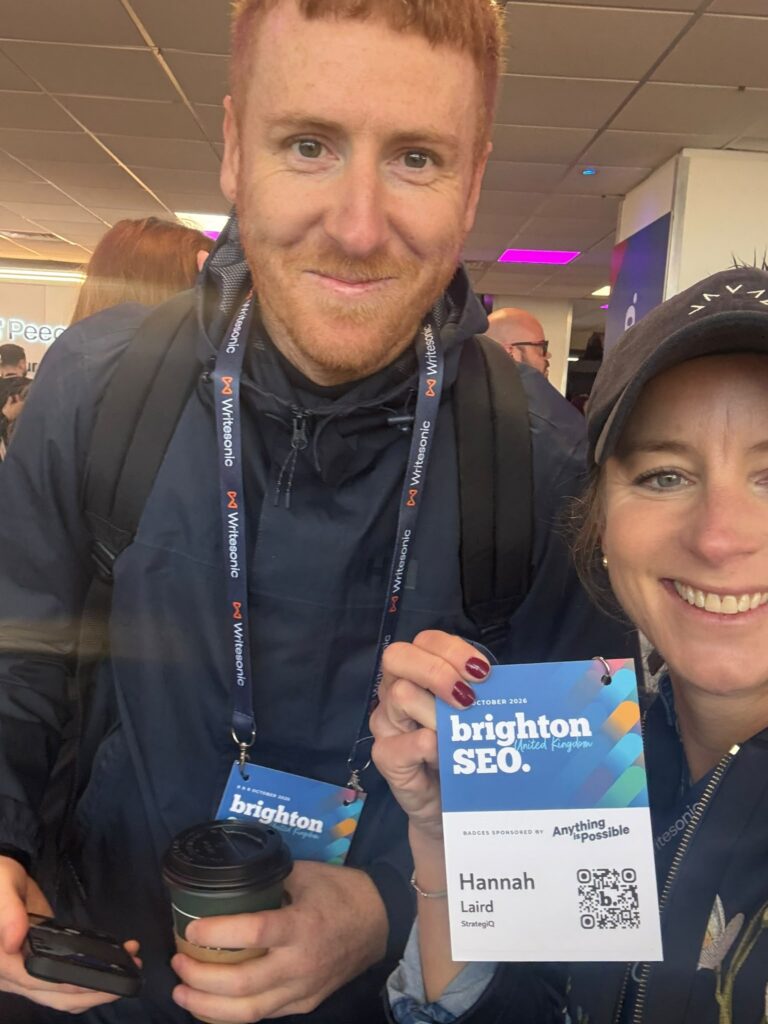
Alongside the main stage sessions, our Head of Search Nathan joined a closed roundtable for agency SEO leads for some honest conversations.
A few things came through.
SEO teams are becoming hubs, not silos. The discussion kept returning to how centrally SEO now sits within broader marketing structures – and the opportunity that creates to pull in wider specialists rather than operate as a separate function. The most effective teams in the room weren’t just running SEO programmes. They were the connective tissue between content, PR, product and brand.
AI has made the basic audit table stakes. Technical audits, crawl reports, quick wins – the kind of work that used to take days and command budget. The room was clear: that’s no longer where the value is. The value comes from showing clients where to put their attention and their spend. Strategic prioritisation. Commercial judgement. The interpretation of data, not just the production of it.
Nathan’s StrategiQ takeaway: “Unique content is the new visibility currency. Four of the main stage talks reinforced the idea that if AI can generate generic content at scale, original insight is what earns visibility. The old keyword-led content playbook isn’t dead, but the brands winning are the ones layering genuine expertise on top of it – owning a topic through perspective, not just presence.”

6. Digital PR now start with prompts
Across the PR talks this BrightonSEO, one idea kept coming up. Success is no longer a link on a high authority site, it’s whether your brand shows up when someone asks an AI a question that matters to them. Rosa Mitchell of Conective3 said: Trying to win the click has become a losing battle. It’s about influencing the choice everywhere people are searching.” We’re moving to a place of Search influence optimisation.
That makes the prompt the foundation of the modern PR audit. It now looks something like this:
- List the questions your customers are asking across different platforms
- Decide what matters most to them. You can see what comes up most often, but this is where human judgement comes in: what stands out?
- Ask what our brand can authentically answer, and where we should enter the conversation
The information gain point comes back into play here too. Jessica Hulbert of Hendy Group argued the strongest answer pairs proprietary data with a named expert, because AI favours unique information over copycat content. Every gap is now also a digital PR campaign waiting to happen.
Then there’s the matter of placements. The best ones aren’t always the highest authority sites, they’re the pages being cited for your customers’ questions, because those are what surface in AI answers. Jane Hunt of JBH’s advice: pitch the page, not just the publication, with a specific editor and a specific format in mind.
Amanda Walls of Cedarwood Digital set out a very specific vision for AI’s role in PR going forward. “AI does the vacuuming, the plant watering and the housework.” In other words – let it scan for missed coverage, flag compliance risks and spot link gaps and basically do what it is good at (Amanda had a custim GPT for each of these sorts of task). While the big ideas are all yours.
The StrategiQ takeaway: However helpful the GPTs, they aren’t the one landing on the final campaign idea, even if they help us get there. That’s where we humans still have final say. We become the proactive in reactive PR when we work with AI tools. Because, if we don’t, what are we putting out? Noise on top of noise.
“The best PR starts with a question – what is happening that nobody has measured? People suspect it but it isn’t yet quantifiable.” — Madeleine Lambert, Originality
The StrategiQ takeaway
The technical fundamentals still matter. Crawlability, structured data, schema, site architecture – none of that goes away. But the layer above it – the question of whether AI agents trust, understand and recommend your brand – is being decided by something different. By consistency across every channel. By genuine expertise, captured and published. By content that adds something to the conversation rather than recycling what’s already there.
Empathy isn’t a fluffy word. In a search landscape shaped by AI, it’s a competitive advantage.


IT’S ALWAYS STRATEGY.
Sources: