
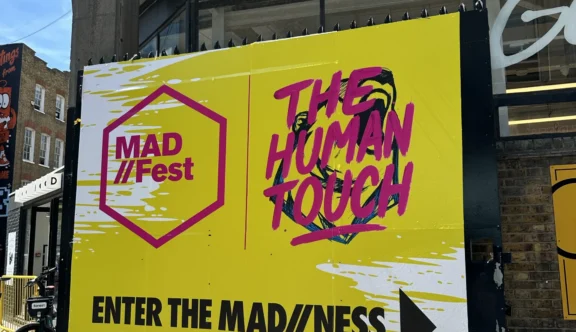
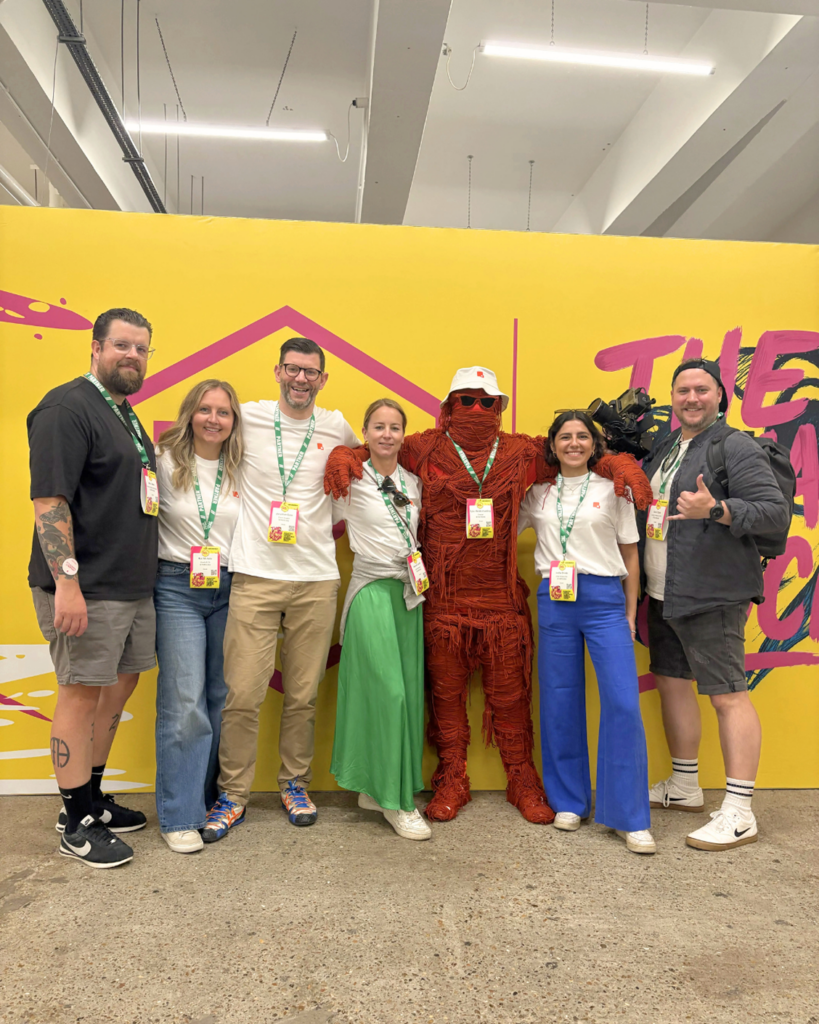
Nine of us descended on MAD//Fest today – Andy, Sarah, Hannah, Tyler, JD, Liv, Nick, Nat and India – representing StrategiQ as a festival partner and, if we’re honest, very keen to see what 15,000 marketing and advertising people make of a man wrapped entirely in orange thread wandering around the venue.
MAD//Fest 2026’s theme is The Human Touch. A deliberate counter-argument to a year in which AI-generated content has become so ubiquitous that audiences are actively developing a radar for it. The timing couldn’t be better. The festival’s bet is that the industry is ready to talk seriously about what separates human creativity from automated competence and whether brands are getting that balance right.
Judging by Day 1: the conversation is well overdue.
Key takeaways from day 1:
- Getting AI to do creativity for you is like “getting someone else to have sex for you”.
- Louis Theroux asked where your ad spend is actually going.
- Bodyform built the fastest growing feminine care brand in the world by refusing to smooth anything over.
- 45% of people say shared cultural moments are rarer than a decade ago. Here’s why that matters.
- CMOs want thought partners, not suppliers.
- The recipe for advertising magic = Cultural connection + timing + bravery.
- What Gen Z really wants from brands.
- People talking to people supercharges reach – lessons from Macdonalds.
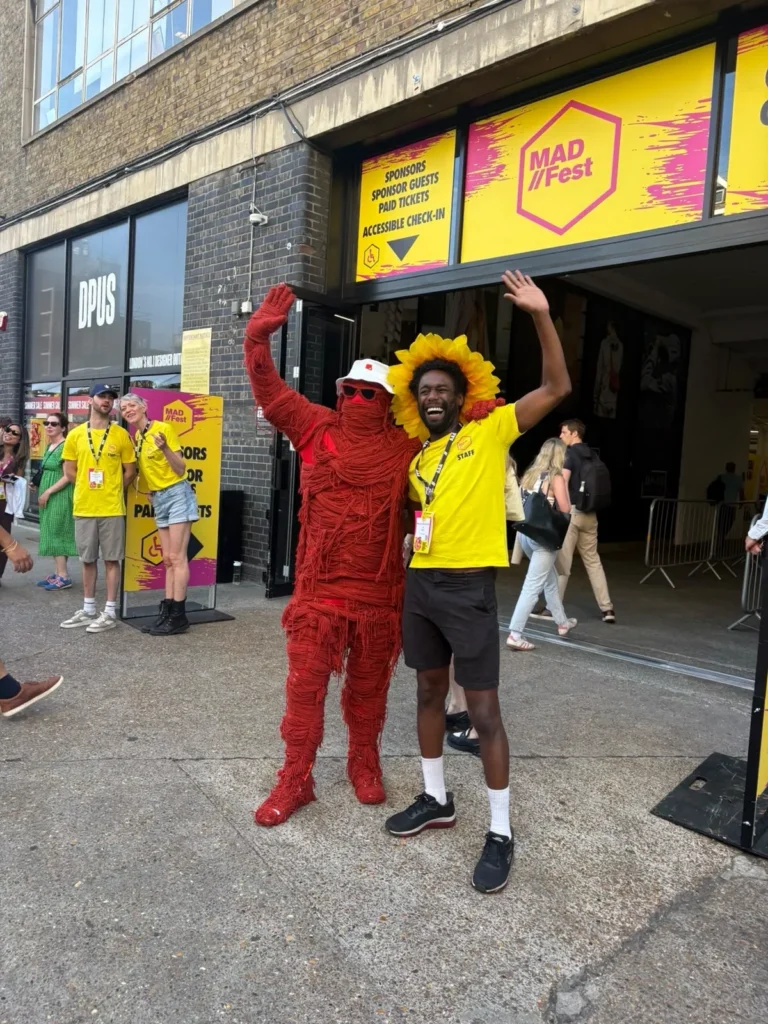
- A man wrapped in orange thread walked around MAD//Fest and nobody could stop talking about him.
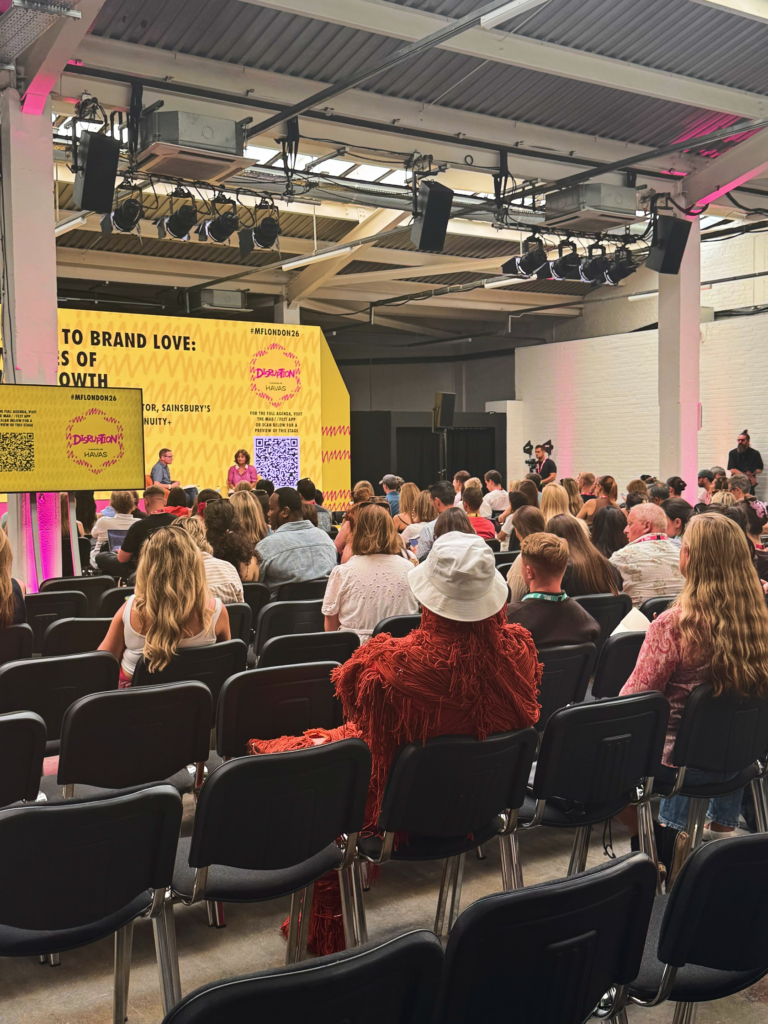
1: Nils Leonard and Vicki Maguire: Stop lying to yourself about creativity
Nils Leonard (Uncommon Creative Studio) and Vicki Maguire (formerly CCO at Havas London and Grey London) opened the Creativity Stage with the central argument: the industry is outsourcing the best bit.
According to Nils, getting AI to do creativity for you is denying yourself fun. “It’s like getting someone else to have sex for you.”
The point being that the struggle, the effort, the wrestling with an idea isn’t the inconvenient part of creativity. It is creativity. And audiences can feel when it’s been skipped. He called it “the weight of endeavour” – the sense people get when they encounter something that someone clearly gave a damn about making.
Vicki was equally blunt: “If you can’t be bothered to write it, I can’t be bothered to read it.”
Some more of our favourite quotes from the day:
- “AI, argued Vicki, is good at giving people what they want, at being ‘good enough’, but ‘good enough’ isn’t good enough”.
- “The Sex Pistols and the Rolling Stones weren’t giving people what they wanted, they were creating something completely new.” – Nils
- “Let’s stop offering our opinion and let’s start doing some f**cking work. We need to get out of our own asses and into the real world because that’s when we’ll make a difference. Less rockstar, more listening. Have conversations, don’t broadcast.” – Vicki
The StrategiQ takeaway: This wasn’t an anti-AI talk. It was a pro-effort talk. The argument isn’t that AI is bad but that using it to avoid the hard part of thinking is an error. The hard part is the value. Consumers know when something was made with care and when it wasn’t. They might not be able to articulate it, but they feel it. The brands investing in “the weight of endeavour” are building the kind of cultural reference points that compound. The ones optimising for ‘good enough’ are building something that’s already being forgotten.
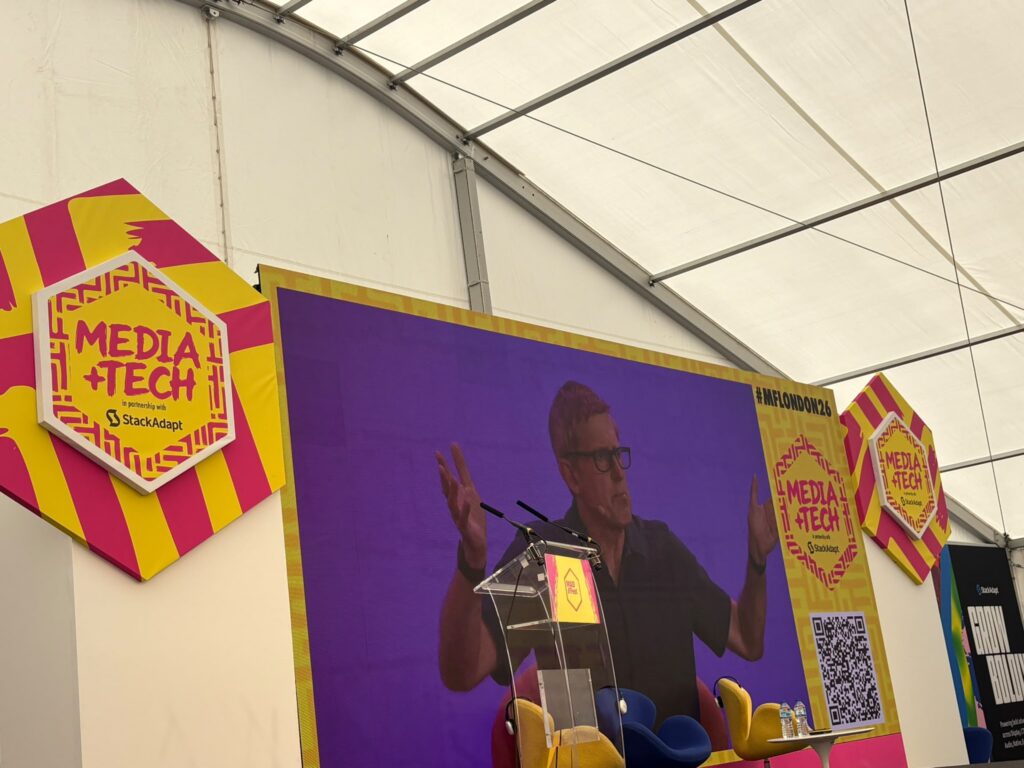
2. Louis Theroux on Algorithms, Advertisers and Toxic Content
Louis Theroux took to the Hex Stage fresh off his Netflix documentary Inside the Manosphere and he arrived with questions the industry would rather not sit with.
The session was framed around the tension at the heart of MAD//Fest’s theme: in a world becoming increasingly polarised and detached, what responsibility do brands and marketers carry for the culture they’re funding?
The uncomfortable statistic he put in the room: 80% of internet content is adult content.
“Everything gets so chopped up you don’t know where your spend is going.”
Sponsored content should be clearly identifiable, Louis argued. The algorithm that determines what your kids see should be more transparent, controlled and better policed. The tide of clickbait, in his words, is “merciless.”
There’s a generational dimension to this. A rising audience has grown up on streaming. These are people whose media diet has been shaped entirely by algorithmic curation, with little transparency about who’s doing the curating or why.
His closing point was the sharpest one for brands in the room: if you have values, your media spend should reflect them. The collaborators you fund, the platforms you appear on, the content you sit beside – all of it sends a signal about what you stand for, regardless of what your brand guidelines say.
“If your brand has values, you want to support the values your brand has.”
The StrategiQ takeaway: Brand safety is usually framed as a risk management exercise – protect the brand from association with bad content. Theroux reframes it as something more fundamental: consistency between what a brand claims to stand for and the media ecosystem it chooses to fund.
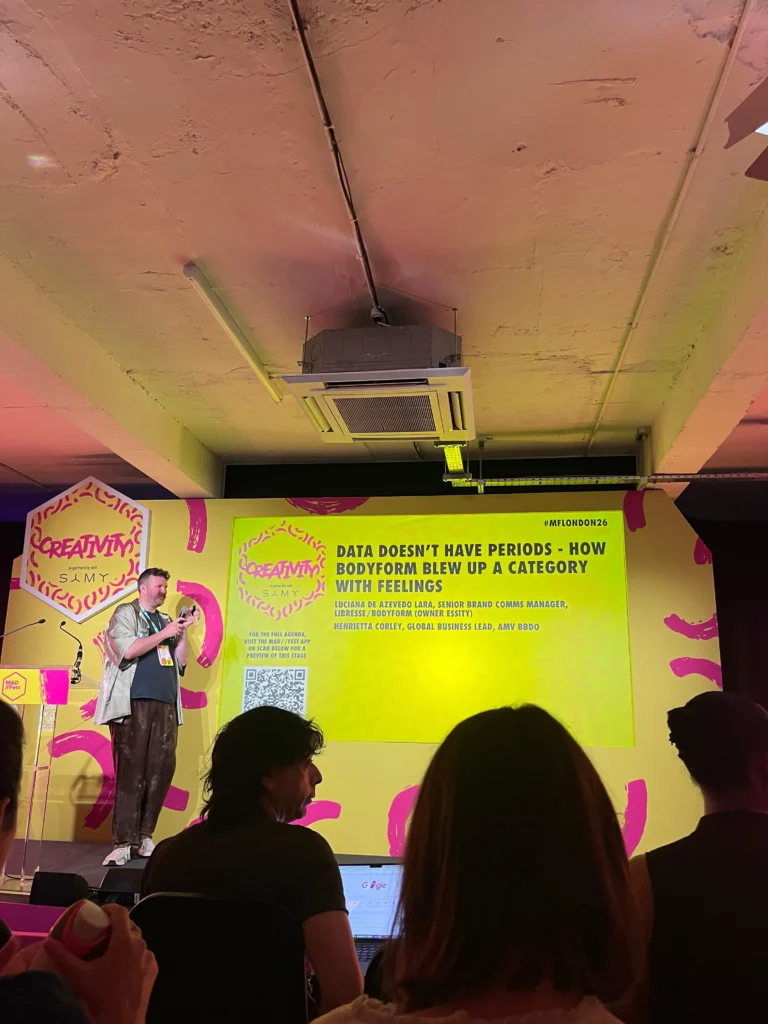
3: Data doesn’t have periods – how Bodyform blew up a category with feelings
Henrietta Corley (AMV BBDO) and Luciana de Azevedo Lara (Libresse/Bodyform, Essity) took to the Creativity Stage to look back on a decade of work that turned a functional hygiene category into something people actually feel something about.
The starting point was a concept they called “data with a soul” – research designed not to measure straight statistics but to capture emotional truth. What do women actually feel? What experiences are universal but go unspoken?
The work that followed – period blood shown for the first time, honest portrayals of breastfeeding and perimenopause, the full physical reality of being a woman – was built on that foundation.
One stat stopped the room: women adopt AI at rates 25% lower than men. This means that creativity, storytelling and genuine human moments matter more to this audience, not less.
Their phrase for it: protecting the willingness to feel something. AI sands over the rough edges. Their job was to keep them, because that’s where the truth lives. The hearts, the guts and, yes, the blood.
Bodyform is now the fastest growing feminine care brand globally. Devotion to the team, radical empathy and the courage to show what had never been shown. That’s the formula.
The StrategiQ takeaway: This is what The Human Touch looks like when it’s a commercial strategy. Bodyform grew by having the courage to say something real to an audience that had been talked at, around and past for decades. The brands that will earn loyalty over the next decade are the ones brave enough to keep the rough edges in.
4: Cultural relevance isn’t a vibe, it’s revenue.
Heather Dansie from Newsworks argued that there are two types of cultural relevance.
“The fast, the trendy, the fleeting. And the slow, the deep and the lasting.”
The fast version is a brand jumping on a meme, a moment or a cultural flashpoint because the social team spotted it on a Tuesday morning. It gets impressions but rarely gets remembered.
The slow version is built over time, through consistent presence, having something genuine to say and showing up long enough that the association becomes earned rather than borrowed.
And the commercial case for getting this right is significant. Cultural relevance is a revenue driver and Dansie’s data puts real weight behind that claim.
She broke it down into five elements: visibility, aspiration, authenticity, timeliness and credibility. Most brands are strong on one or two and weak on the rest, which is why so much cultural marketing lands briefly and compounds on nothing.
The stat that landed hardest: 45% of people now believe there are fewer moments that unite audiences than there were a decade ago. The shared moments that used to give brands a reliable on-ramp into culture – a World Cup, a royal wedding, a Saturday night television event – are rarer and harder to own than they used to be. When the shared moments are scarcer, the brands already embedded in culture don’t need to chase them.
The StrategiQ takeaway: Dansie’s framework is useful as a checklist. Visibility, aspiration, authenticity, timeliness and credibility. Run your brand against all five and the gaps become obvious. The fragmentation point is the sharpest signal for media planning: if the shared moments are getting rarer, presence in the environments that still create them – quality publishing, premium editorial, broadcast – is worth more than it looks on a CPM spreadsheet.
5: From adland to brandland
Next was the Hex Stage Brandland panel, featuring former Boots CMO, Pete Markey.
The provocation: adland is giving way to brandland. The talent, the thinking and the ambition are shifting – and the leaders who understand that shift earliest will define the next decade.
On in-house versus agency, the panel was clear. In-house teams know one brand deeply. Agencies understand the landscape. Both matter.
On what CMOs actually want, the honesty was refreshing. The word that kept coming up was “thought partner” – not a supplier or an executor, but someone who genuinely understands the business strategy behind the brand.
The former Boots’ CMO put it directly: “You need a damn good strategy across business and brand. Find an ecosystem within the company to gain the winning edge.”
“The CMO role can be lonely. You want great agency partners.”
The StrategiQ takeaway: Human insight is still missing. Data-driven facts aren’t the only outcome top leadership are looking for – culture is key. The “thought partner” framing is the one that matters most to us. The gap CEOs are describing – a vacuum of strategy, someone who understands the commercial bigger picture – is exactly the gap StrategiQ exists to fill. The best agency relationships are strategic.
6. Connecting the dots: How Unilever finds the advertising magic
The Unilever creative team’s session on the Hex Stage was built around a deceptively simple idea: the best advertising doesn’t create cultural moments but connects the ones that already exist.
Football boots used to be black. Then someone made them pink. One brave move changed an entire category’s visual language overnight.
Find the cultural dots. Connect them. Have the courage to move before the moment passes.
Music was another thread running through the session. It remains one of the most reliable human touchpoints in marketing as it bypasses rational thought in a way that almost nothing else does.
Human instinct is still vital. The recipe? Cultural connection, timing and bravery.
The StrategiQ takeaway: Cultural relevance at its best isn’t manufactured. It’s spotted, timed and executed with enough conviction that it feels inevitable in retrospect. That’s the human instinct no algorithm replaces.
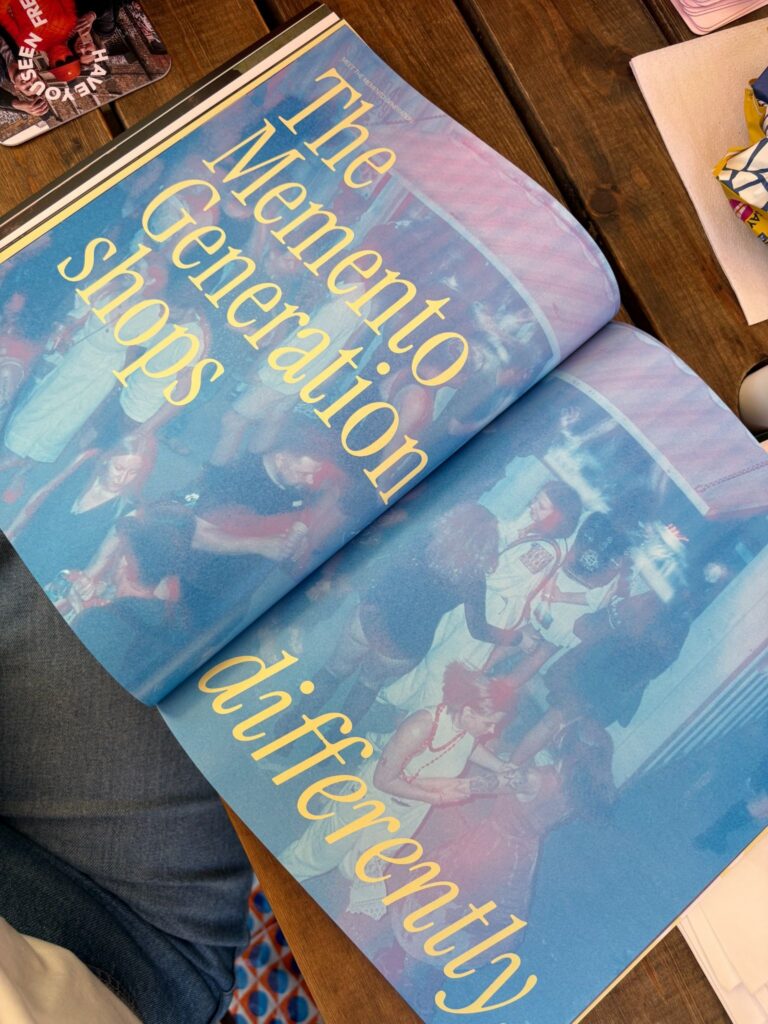
7. The Momento Generation: What Gen Z wants from brands
Snapchat and retail strategist Mary Portas made a case on the Hex Stage that reframes Gen Z shopping behaviour.
The belief: Digital natives want instant everything. Friction is failure. Speed wins.
The reality is more interesting. For digital natives, on-demand culture is all they know – it’s simply what shopping is to them. So what happens when they don’t get the thing right away? What if they have to work for it, or wait for it (remember waiting?). That creates a whole new experience. A different memory. One they’ll tell their friends about.
61% of Gen Z said they’d be willing to wait over 15 minutes for something they really wanted.
The StrategiQ takeaway: Serving the momento generation a rewarding, unexpected dose of friction is the unexploited value-add of today. It’s a white space we as agencies can help brands facilitate.
8. From confidently humble to unashamedly McDonald’s
Hannah, Head of Marketing and Menu at McDonald’s, and a strategist from Publicis took the Hex Stage to explain how one of the most recognised brands on the planet decided to stop being careful.
The starting point was a Leo Burnett line: “At the end of the day, we are just people to people.” McDonald’s has doubled down on the oldest distribution channel in marketing: people talking to people. It builds trust, supercharges reach and, crucially, hacks the machine.
The new McDonald’s marketing model runs on three things: Ambition, Audience and Attitude.
- Ambition: iconic creativity that fuels the moments the nation needs to talk about.
- Audience: broad reach but with a sharper focus on Gen Z because they’re the micro-influencers in every home.
- Attitude: McDonald’s strategy has moved from “confidently humble” to “Unashamedly McDonald’s.” Just a brand that knows exactly what it is and leans into it.
Two recent campaigns prove the model works:
The McDonald’s World Heist was born from a cultural observation: people online were experiencing FOMO over menu items available at McDonald’s locations in other countries. Rather than ignore it, McDonald’s turned it into a campaign. They ‘stole’ menu items from around the world and brought them to the UK. The internet did the rest.
The McDonald’s Secret Menu was, by any measure, a huge success – turning an existing piece of fan culture into an official moment and giving the audience exactly what they’d already been creating themselves.
The StrategiQ takeaway: The brands that win culturally are the ones comfortable enough in their own identity to stop qualifying it. The World Heist campaign and the Secret Menu are textbook examples of what happens when you listen to what your audience is already doing and build the brand around it.
9. Fred woz ‘ere: Were you paying attention?
We also brought Fred.
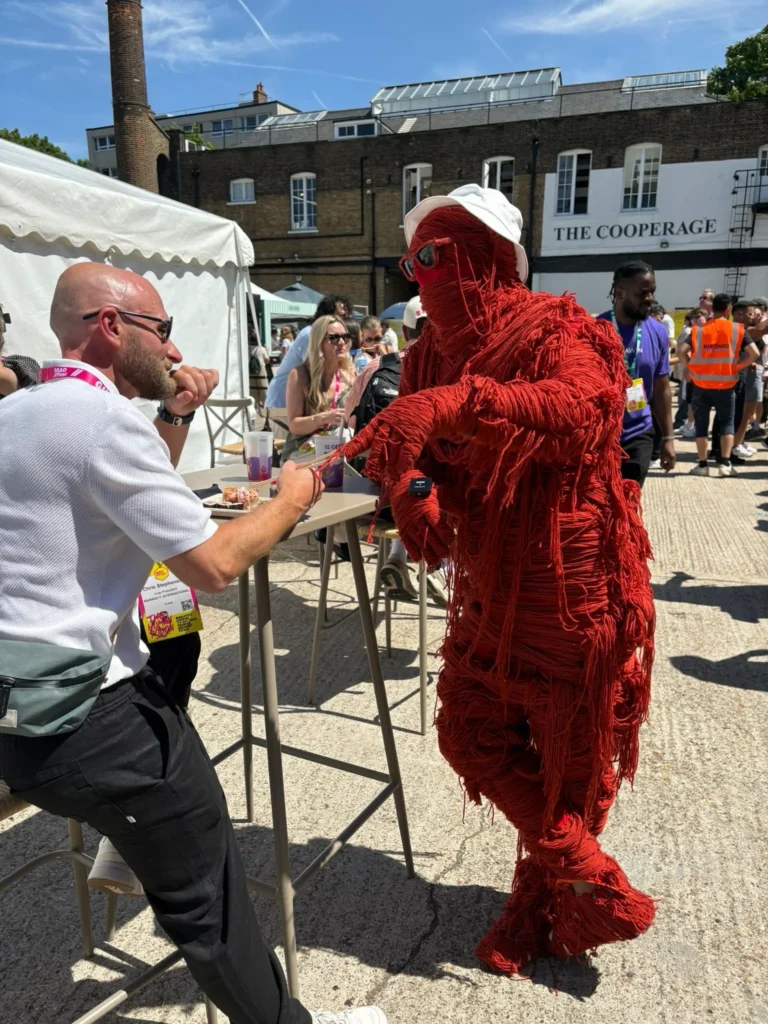
If you spotted a guy wrapped head to toe in orange thread wandering around the MAD//Fest site today in 30℃ heat – that’s our mascot, our metaphor and, as it turns out, a surprisingly effective conversation starter at a marketing festival.
Fred is a physical embodiment of the Orange Thread – the single connecting idea that runs through everything we do for a client. From the first strategic conversation to the last line of code. The brief never ends. It gets woven into everything. Fred is what that looks like when you give it a face and a very good outfit.
Spotted Fred today? Find out more about how you could win lunch at the Ned.
- Take a photo of Fred and post it to LinkedIn with the hashtag #FindFred or tag us @strategiq on Instagram stories.
- Follow StrategiQ on LinkedIn or Instagram.
- One lucky winner will win a Kaia Brunch for four at The Ned London. Ends 11:59pm on Sunday 12th July 2026. See full Terms & Conditions.
If not, don’t worry, he’ll be causing havoc tomorrow too.
The StrategiQ takeaway
Day 1 of MAD//Fest 2026 made the case (loudly) that the most dangerous thing a brand can do right now is mistake efficiency for creativity. The tools are faster than they’ve ever been. The thinking still has to come from somewhere real.
The Human Touch theme isn’t a nostalgia trip. The brands that will compound over the next decade are the ones with a clear enough identity, a consistent enough voice and a genuine enough point of view that no amount of AI-generated content can dilute them.
We’re back tomorrow for Day 2. Fred will be there too.
Sources: