
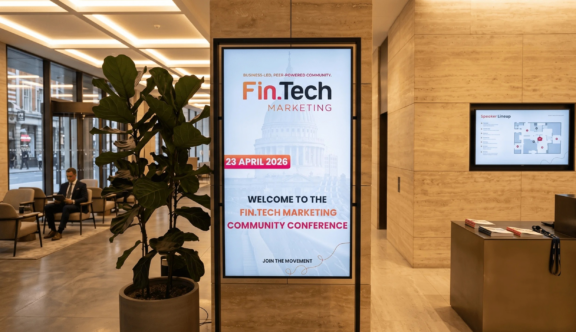
The City rises early. Does it ever sleep? The Market opens at 6 am sharp, and London has a duty to fulfil, as Europe’s financial capital – and, more arguably – as the financial capital of the world. Two claims put forward by Deputy Mayor for Business Howard Dawber OBE in his opening words at the latest Fin.Tech Marketing Global Conference. More on that later.
The event took place at Moorgate’s 1 Basinghall Avenue, amidst the modern offices and monuments of London’s financial district. Where else?
The topics tabled: everything from AI agents to brand reputation, revenue growth to the real shape of the 2026 marketing funnel.
For many, the conference wasn’t just about catching up with the industry. It was more a case of helping decide what it could become. How much AI is helpful and acceptable? How should sales and marketing be speaking to each other?
Yes, there was uncertainty, an understanding that Marketing in financial services is being asked to do more, prove more and move faster than it ever has – against a backdrop where the tools are changing weekly. But there was also a willingness to listen, to experiment, to strive to do it better while staying compliant and true.
Here’s what we took away from the event.
The opener
Speakers: Payal Raina Fin.Tech Marketing Conference Founder
Howard Dawber, Deputy Mayor of London for Business and Growth
Payal quipped about the tube strikes and what the future holds for Transport For London and AI (hopefully, plenty). She spoke about growing the Conference from 100 curious, passionate, restless people… into what it is now: 23,000 marketers from all sorts of verticals and workplaces.
Howard boldly pitched London as the greatest financial hub in the world, above its European counterparts, even above San Fran and NYC. Because of a unique benefit: everyone is together. The venture capitalists, investment bankers and established service providers. Fintech startups. You name it. The regulators are nearby too.
Martech 2026: Everything, Everywhere, All at Once
Speaker: Scott Brinker, Editor, Chiefmartec
Scott Brinker – aka the ‘Godfather of Martech’ – was next.
He showed us that AI agents and martech tools are doing anything but slowing down and consolidating, exponentially growing 100x since 2011. More surprising was that Scott had tracked 15,000 martech tools and had insights on how they are being used. For example, despite the volume of options, a small proportion of the tools are well-known and widely adopted.
What does Scott see as the next stage? More customised platforms with modules you can plug in to suit your needs.
Scott joked ‘vibe coding’ has been around since phrases like ‘hustle culture’ and ‘growth hacking’ entered the lexicon. He also told us to try vibe coding for ourselves, especially for use cases in the past not seen as ‘worthy’ of big dev budgets, quoting Linus Pauling:
“The best way to have a good idea is to have a lot of ideas.”
“Congratulations,” Scott said. “You’re all software engineers now.”
Allica Bank: what the UK’s fastest-growing company learned reinventing itself around AI
Speaker: Conrad Ford, Chief Product & Strategy Officer, Allica Bank
Allica Bank’s trajectory is remarkable – it’s the fastest-growing company in the UK. But Conrad made it very clear that Allica entered as a challenger. They had a clear target market (SMEs) and a clear strategy. They are now ‘the challenged’ and this changes how they operate.
Everyone at Allica must be AI literate. This is non-negotiable in the company’s core values. It enables core banking teams to work in agile ‘squadlets’ of fewer people than traditional banking teams, using AI where it makes sense and human intelligence everywhere else.
Conrad said something that resonated:
“Not everyone has to like the challenger. But 10% will love us. And that’s my rule for every decision. I’m stubborn on the vision, flexible on the details.”
He also told us if it were 100 years ago, we’d all be wearing black bowler hats, as was traditional for bankers in the nineteenth century.
StrategiQ had a say. Keynote fireside: building the modern revenue growth engine
Andy Smith, CEO, StrategiQ (Moderator)
Speakers: Melanie Mills (Commercial Director, Paycaptain. CEO/Founder Connexion Career Collective), Andrew Carrier (InMarketing), Margaret Totten (Yavrio)
Andy Smith, a familiar face for the StrategiQ attendees, led a discussion about aligning business, brand and tech for growth in all forms.
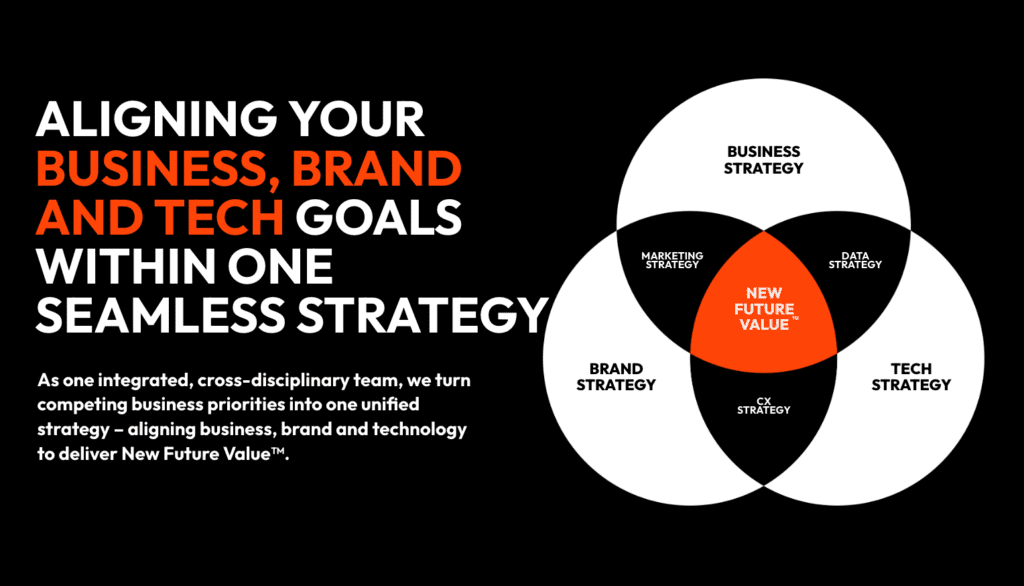
What came up loud and clear was that ‘revenue growth’ for one party isn’t sustainable or practical without the right approach to doing business.
Margaret said: “How you grow has changed. It’s about momentum across the whole business. Enabling teams to win. Really listening to customers. Showing how your product can solve an expensive pain point.”
Mel agreed, speaking about the importance of a growth mindset and actively hiring for that trait. Because that’s how you grow your business longterm.
Andrew called for a ‘reputation first’ approach. “We work in a sector where we sell trust. So start with reputation, then think about revenue later. Really, you’re dealing with a messy spaghetti ball, not a clear marketing funnel, so what people say and think about you matters. Growth is trust compounded.” What a line.
The conversation soon turned to blockers. With Andrew saying these often come about through poor positioning; “It’s about figuring out the benefit to the core customer and telling them why you fit them.”
It’s better to be the ‘only’ than ‘better’ than your identical competitors.
Mel reminded us not to get caught in ‘decision making paralysis’. “We just need to get going, experiment.” She also drew attention to the fact that; “We’re not doing this alone. So, pick your partners carefully and make sure you’re all on the same journey.”
Andy summed it up, finishing: “Obsess over the detail. Growth is a choice, and how we turn up in our organisation shapes the culture. Don’t underestimate what you can make happen in 6 months time.”
Stand-out moments from the day
A pinch of magic
Logic Logic Magic’s Creative Partner & Co-Founder Alistair Ross showed that characters are ownable and memorable – even in financial marketing. They just can’t be meaningless mascots. He did so while wearing a green blazer and yellow t-shirt that no one in the audience would forget.
Alistair introduced us to Soldo’s bespoke 3D rigged hummingbird – a realistic animation in the Soldo colours that greatly boosted awareness for the brand. He warned Lloyds not to remove their horse from their marketing again. It didn’t go well for Lloyds the last time.

Soldo’s animated hummingbird
“It’s personalisation done badly if the customer knows it’s personalisation”
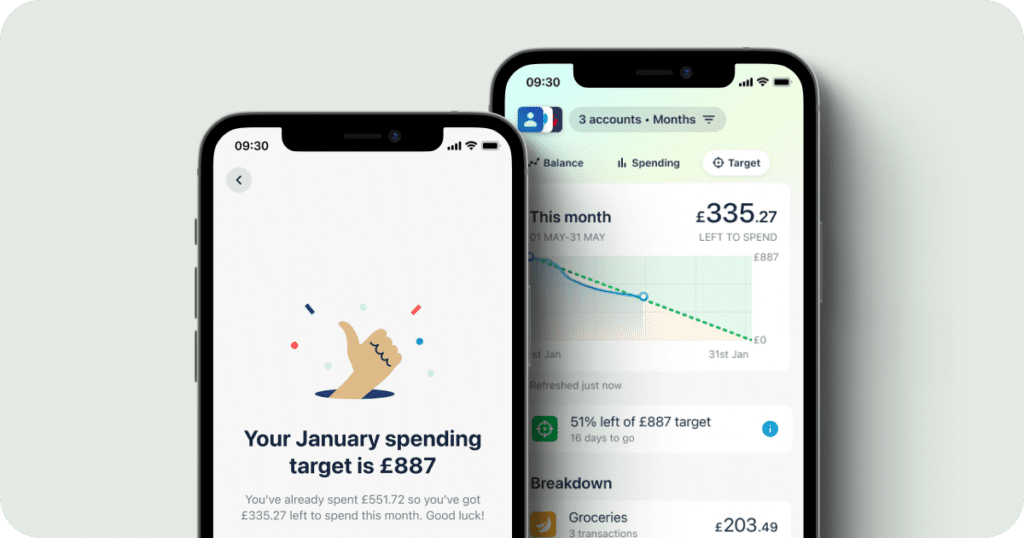
Farhad Divecha, Group CEO, Accuracast reminded us that the Monzo and Revolut summaries for consumers on how they are spending their money… That’s actually personalisation done really well. It’s the same reason we love SpotifyWrapped. Data, played back to us, that’s genuinely useful and means something to us. Yes, please. Personalisation done badly ‘Hi StrategiQ’ at the top of a clearly autogenerated email, or worse – ‘Hi , Mr ,’ – is the issue.
“B2b marketing is like Tinder – you have to look good”
Ashish Babu, CMO Global Markets, Tata Consultancy Services was interviewed by Moderator Stephen Body, Head of Marketing, TraditionData. Among his wise words was the idea that b2b marketing (especially LinkedIn) is like the dating app: “You have to show up and look good.”
But what Ashish was really referring to was his wider point. There are a few things you can’t measure, yet we all know matter: reputation, good will and why exactly some leads convert.
What we’re taking home
If the Conference taught us anything it was that we’re on the brink of something. You could feel it in the air. The AI era has already dawned – and it made its way into every talk, every panel, every conversation in the corridors.
Conrad Ford spoke about his now infamous AI memo to his Allica team, saying the moment is here ‘we’re going all in on AI ’ (or you can re-think your job status). He likened it to Bill Gates throwing Microsoft fully, whole-heartedly into the internet in 1995.
Scott Brinker suggested marketers try to approach it sensibly, with the ‘crawl walk run’ formula. Then showed us it’s always more like: crawl, fall, teeter, walk, fall… and then call for help.
Thanks to Payal Raina and the Fin.Tech Marketing Community team for putting together a day of debate and discussion that will surely inspire many more conversations, once we’ve all digested the takeaways and brought them to our colleagues and clients.
Want to talk through what any of this means for your brand? Get in touch with StrategiQ or find out more about our full-funnel marketing services. It’s always Strategy.