
There’s a question that doesn’t have a clean answer yet. But it’s one every senior marketer and growth lead should be sitting with right now.
If a prospective buyer never searches for you – if instead they ask an AI to compile a shortlist, and the AI decides which brands make the cut – what does ‘visibility’ actually mean? And if the machine is doing the looking, where does the human element come into it?
It sounds, at first, like a question about technology. It isn’t. It’s a question about how buying decisions are made – and always have been.
Key takeaways:
- Put simply, AI filters what humans get to decide between
- ‘Visibility’ now means being present and credible in the AI-mediated research phase as much as anywhere else
- Knowing how AI currently describes your brand is the starting point for everything else
- The human element hasn’t moved. But a new shop window is wide-open, and brands not on the AI shortlist are being shut out at the decision stage
- The good news? The signals that earn AI credibility – specificity, third-party validation, consistent authority – are the same signals that earn human trust
The shortlist has always been the battleground
Think about how buying decisions have always worked.
Most buyers, for most purchases above a certain value, don’t evaluate every possible option. They construct a shortlist – consciously or not – from the brands they’ve already encountered, the ones recommended by peers, the ones that surface when they start researching and the ones that seem credible in the context of where they’re looking. The final decision happens within that list.
For decades, search engines were the primary mechanism for shortlist formation in the research phase. You typed a query. You got a results page. The brands that appeared – prominently, credibly, consistently – had a chance. The ones that didn’t, didn’t.
What’s changed is who – or what – compiles the list.
What the machine actually does
When a buyer asks an LLM to ‘recommend the leading suppliers in a category’, or ‘compare the main options’ or ‘explain what separates the credible players from the rest’ – the machine synthesises.
It draws on everything it has been trained on:
- Your website
- Your thought leadership content
- Your press coverage
- Your reviews on third-party platforms
- What people say about you in communities and forums
- How analysts and industry publications characterise your category
It looks for corroboration and rewards brands that have a clear, well-evidenced point of view – and it struggles to confidently characterise brands that don’t.
The machine compiles an aggregated impression of your brand – from every signal you’ve ever generated, and every signal others have generated about you. That impression determines whether you’re listed, how you’re characterised and whether the buyer is encouraged to consider you.
Visibility, in this context, means being understood clearly enough, and trusted widely enough, that the machine includes you – accurately – when it matters most.
| Half of consumers now intentionally seek out AI-powered search engines to make buying decisions – including a majority of baby boomers. McKinsey & Company, 2025 |
So where does the human element fit?
People are still making the decisions. We like the buying part. Dopamine, serotonin and endorphins are in fact released when we shop (Web MD), making us feel good. And people are still approaching purchase decisions with trust, familiarity, aspiration and emotion.
With high-value purchases especially, we still do due diligence – reading the case studies, watching the founder’s interview, asking a peer who’s used them. The final ‘yes’ still requires a human to commit.
What AI has changed is the upstream filter. The human element now operates on a pre-curated set of options. And that curation – which brands make the list, which are described favourably, which are surfaced for which queries – is increasingly happening in an AI interface before the buyer has interacted with any brand directly.
There’s a new judge with the gavel – AI. The jury is still human.
What visibility actually requires now
If visibility means being accurately represented in AI-mediated discovery, the question becomes: what does that require of a brand?
The answer is less exotic than most people assume. LLMs reward what good brand building has always required. The brands that show up clearly and confidently in AI answers are the ones that have done the work:
- A specific, well-defined point of view. If your brand could be any brand in your category, the machine will treat you as interchangeable. Your unique selling point is now, as much as ever, a visibility strategy.
- Third-party validation. LLMs synthesise Trustpilot reviews, Reddit discussions, earned press coverage, analyst mentions and industry publication contributions. Your website is one data point. The machine needs to see it reflected back from other sources.
- Consistent authority signals. A brand that says one thing on its website, something different in its thought leadership, and something different again when it shows up publicly is problematic for AI. It will struggle to characterise you with confidence. Instead, shoot for consistency.
- Genuine human voices. LLMs value individual expertise. Thought leadership under your senior leaders’ names – in publications, on panels that generate written coverage, in communities where your buyers think out loud – builds a layer of authority that brand content alone can’t replicate. The machine notices that your organisation contains real experts. That distinction matters when it’s deciding who to recommend. In fact, LinkedIn has been declared the most-cited domain for professional queries in AI search (Profound).
So what’s new? We’ve all been ‘doing’ LinkedIn and PR for years.
Well, getting these wrong now has a more immediate and less visible cost. You don’t see the traffic you never received, and you can’t measure the shortlist you were never on.
“Brands that have been building a consistent narrative for a while have a head start. More than ever for SMEs, having a consistent cadence for pushing out good, relevant content is important. It’s your chance to help LLMs answer the key questions and help your brand be discovered” Glenn Frates, Regional Vice President. PR Newswire.
“PR can often feel fast and reactive. But there’s actually a lasting shelf life to strong campaigns and brand stories. It all serves your brand long into the future. There is a huge, ongoing well of data AI uses to make its final decision. Your underlying narrative matters – there’s this cumulative effect as you build the foundations of your reputation.” Scott Newton, Director, Solutions Consulting
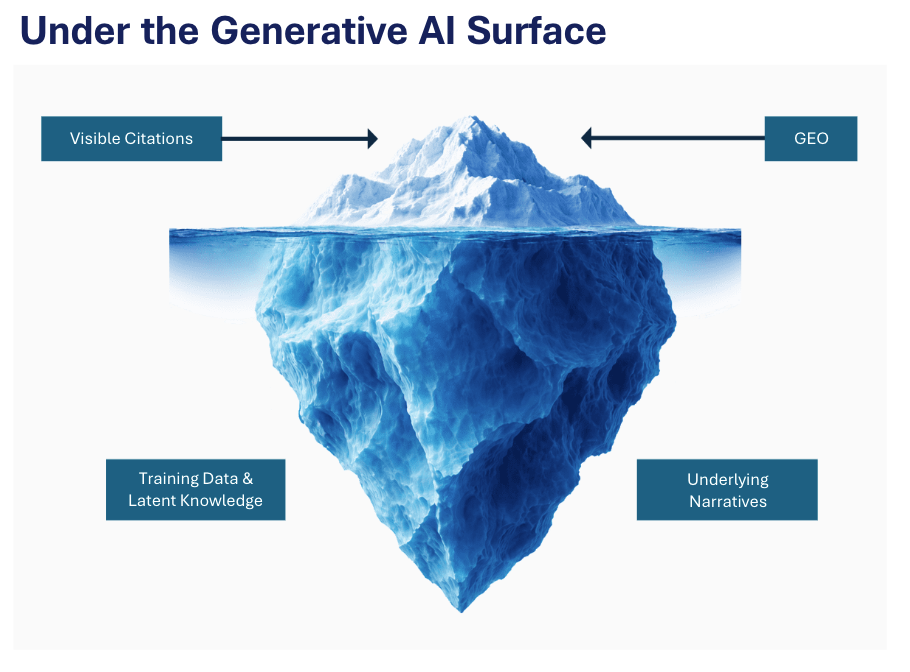
Taken from: Cision Webinar GEO: Owning the AI Summary
The question that follows
Wondering how your brand is being seen by AI? We can help you understand how you’re actually perceived, not just how you’d like to be.
Answer 10 quick questions to build a clearer picture. Warning – it only works if you’re ready to be real.
Sources and references
- The Great Visibility Shift, Panel – StrategiQ and GTA – Future of Work
- McKinsey & Company: New Front Door to the Internet – Winning in the Age of AI Search
- Mintel: AI in Consumer Marketing & Agentic Commerce Forecasts, 2025
- BrightEdge: One Year of Google AI Overviews
- Search Engine Land: State of Search Q1 2025
- Profound: LinkedIn is the most-cited domain for professional queries in AI search
- Cision webinar – GEO: Owning the AI Summary