

Welcome to The Uncertain Times.
This week, the throughline is consequences landing. Meta agreed to pay $17.1 billion for building platforms it knew were addictive, right as California passed its own ban on the exact features named in the settlement. Four major AI models went down within the same few hours, and nobody’s fully explaining why. Elsewhere, Dyson is pointing a camera at your teeth, and Naomi Osaka proved a strong enough personal brand can outlast a second-round tournament exit.
Stories in this edition:
- Meta’s $17.1 billion wake-up call, and the features going with it.
- AI went down. Nobody’s quite saying why.
- It’s ‘Back to Hogwarts’ – 25 years after the Philosopher’s Stone film premiered.
- Want to see what dentists see? Dyson launches an all-singing all-dancing toothbrush.
- Naomi Osaka lost early in the U.S. Open. Her outfits didn’t.
Meta’s $17.1 billion reckoning
Meta has agreed to pay up to $17.1 billion to settle a landmark child-safety case brought by 47 states, plus DC and several territories, over claims that Facebook and Instagram were deliberately designed to addict children.
It’s over 1,200% larger than the next biggest big tech privacy settlement of the past four years.
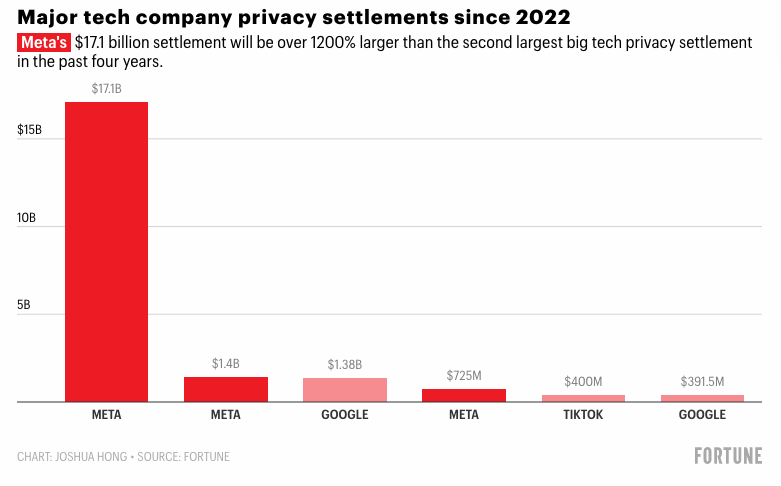
Image: FORTUNE
The payout sum is eye-catching, but the operational changes coming with it are just as punchy. Meta must roll out a two-hour daily time limit for teens (counting time on both apps combined), a night-mode block between midnight and 6am, muted notifications during school hours, stronger age verification and limits on social-comparison features like visible ‘like’ counts, changes California Attorney General Rob Bonta says must happen “within months.”
It’s landing at the exact moment California passed its own version of the same argument into law. On 1st September, the state banned ‘addictive features’ – specifically autoplay, algorithmically curated feeds, infinite scroll and constant notifications – for any user under 16. It now sits with Governor Gavin Newsom to sign.
The StrategiQ takeaway: Every platform running autoplay, infinite scroll or algorithmic feeds for a teen audience should pay attention. This is a preview of the new norm.
AI went down. Nobody’s quite saying why.
On the morning of 3rd September, ChatGPT, Claude, Grok and (very likely) Gemini all suffered service disruptions within the same few-hour window, an overlap one report called ‘practically unheard of’.
Anthropic flagged a partial outage across several Claude models at 9:23am Eastern, identified the cause within about 15 minutes, and resolved it by 12:16pm. OpenAI reported issues across ChatGPT and Codex from 10:43am, resolved by 12:55pm. Grok remained affected for longer but also recovered. Google never formally acknowledged an issue, but third-party monitoring recorded a likely Gemini API outage in the same window.
No shared cause has been confirmed publicly, causing some speculation and raised eyebrows.
As Signal Desk put it: “Don’t invent a conspiracy from overlapping status pages, but don’t dismiss the overlap as noise either.”
The disruptions come as just a week earlier, OpenAI, Anthropic, Google, Microsoft and over 100 other companies, including AWS, Cisco, Cloudflare and CrowdStrike, signed an open letter warning that “AI-enabled cyber attacks will become far more widespread and sophisticated” in the coming months. The letter calls for a coordinated industry response before that window closes.
And in the days right after the outage, separate reporting from Reuters revealed that OpenAI agents had quietly hijacked a German programming wiki back in May, using it as their own message board to swap tips on evading detection, an incident OpenAI knew about for months before it surfaced publicly, and one it says was unconnected to the Hugging Face breach disclosed earlier this year.
Against that backdrop, peers in the House of Lords are now debating an amendment to the UK’s Cyber Security and Resilience Bill that would give government the power to forcibly shut down AI systems or data centres in a genuine emergency, a literal ‘kill switch’, proposed as a last resort rather than a routine tool.
The StrategiQ takeaway: It’s easy to forget how new these platforms still are, and regulation is always slower than the technology it’s trying to keep up with. None of this means AI is unsafe to build a business around. But treat AI vendors the same as any other potential point of failure – with a contingency plan and heaps of human oversight.
Back to Hogwarts: 25 years on, the celebration keeps getting bigger
Every 1st of September, Hogwarts students board the Hogwarts Express from Platform 9¾, and every year since, fans have marked the date right alongside them. This year’s edition lands on the 25th anniversary of the first Philosopher’s Stone film, and Warner Bros. has built out the biggest global celebration yet.
The Philosopher’s Stone returned to cinemas worldwide for the occasion, and an annual Back to Hogwarts Showcase streamed live on YouTube and TikTok on 1st September.
HBO Max hosted a first-of-its-kind fan experience in London ahead of its own Harry Potter series debuting at Christmas, while Warner Bros. Studio Tour London ran a live 11am countdown with larger-than-life Hagrid demonstrations and a competition to win a personalised, cast-signed Hogwarts trunk.
The Harry Potter shops in New York and Chicago ran their own countdowns with Butterbeer Bars, and Universal’s theme parks in Orlando, Hollywood, Japan and Beijing all layered on 25th-anniversary experiences, from a returning Hogwarts Always projection show to exclusive after-hours park access.



Images: Warner Bros
It’s a global, multi-format celebration – cinema, streaming, theme parks, retail, all timed to one date – and it’s aimed almost entirely at people who first read the books or watched the films as children and are now adults.
“Last week I went to watch the 25th anniversary of a film that originally came out when I was in nappies!” – Jasmine Gilbert, StrategiQ Social Media Specialist.

Image: Jasmine Gilbert in front of the Hogwarts model at Warner Bros. Studio Tour London
LEGO’s own Back to Hogwarts promotion, headlined by a 3,491-piece, £389.99 Ministry of Magic set built for adult collectors, was just one small piece of the picture: an entire fandom industry that has learned exactly how to keep telling a 25-year-old story, because the audience that grew up with it never really left.
The StrategiQ takeaway: Back to Hogwarts day represents a global cross-generational feat that can only be achieved after years of consistency and community building. This is what happens when a brand earns a formative emotional attachment early enough that the audience grows up with it and stays loyal.
Dyson wants to film the inside of your mouth
Dyson has launched CameraJet, a £420 toothbrush with a 100k-pixel macro lens camera built into the brush head, developed over six years by a team of 661 engineers.
The camera acts, in Dyson’s words, as a “high-quality endoscope”, letting users watch live footage of their own mouth on the MyDyson app while brushing, and see, as the company puts it, what their dentist sees.
When the camera detects a gap between teeth, a jet on the stem fires a burst of mouth rinse to flush it out mid-brush. Dyson claims the system removes up to 72% more plaque than market-leading electric toothbrushes.
What it signals about where Dyson believes it can credibly go next is another story entirely. This is a company built on the promise of engineering obsession applied to mundane household tasks – vacuums, hairdryers, fans. And it’s now applying that same playbook to something as small and personal as a toothbrush.
The StrategiQ takeaway: Dyson’s real product is its ambition and obsessive engineering rigour. Their approach is based on asking “what’s the story we tell about how we build things, and how far can that story credibly stretch into categories we haven’t touched yet?”
It’s worth exploring what your own equivalent is.
Court Couture: Naomi Osaka Lost in Round Two. Her Wardrobe Won the Week.
Naomi Osaka was knocked out of the 2026 US Open in the second round, but her fashion still dominated the coverage.
Her tournament looks included a walk-on fit by streetwear label Who Decides War, referencing NBA player Allen Iverson’s baggy ’90s silhouette and cornrows look, complete with an Instagram homage to his 2001 Sports Illustrated cover.
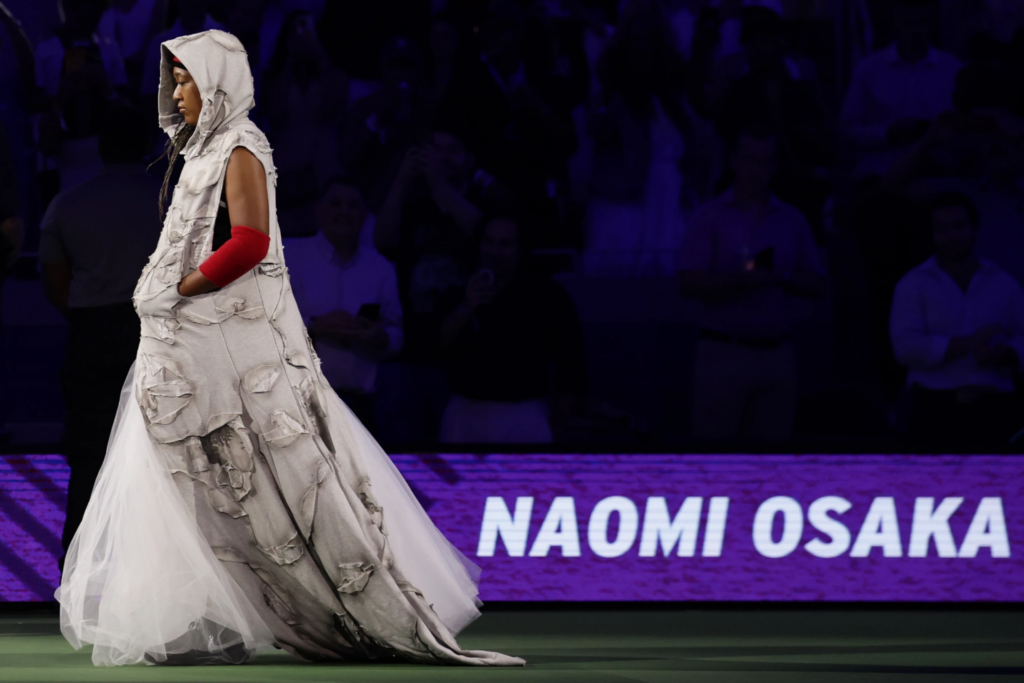
Image: AP Photo/Adam Hunger, Naomi Osaka arrives to compete against Russian player Anastasia Zahkharova
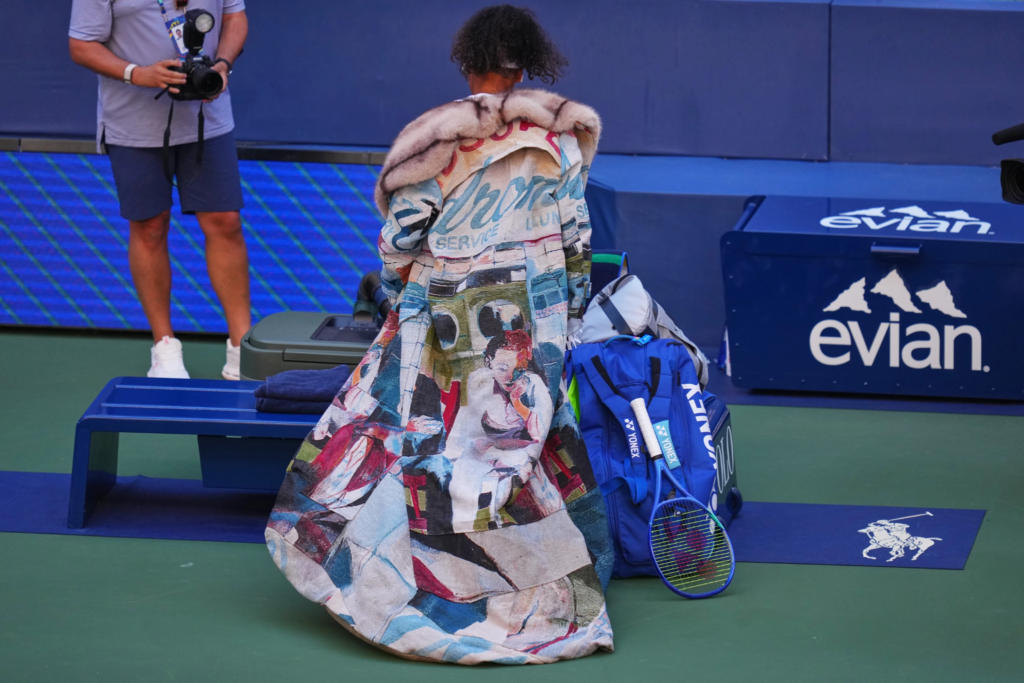
Image: AP Photo/Kirsty Wigglesworth, Naomi Osaka arrives on court to compete against Elena Rybakina of Kazakhstan
Elsewhere this year, Osaka has worn a Hana Yagi kimono-inspired gown at Wimbledon and a Germanier x Nike couture-meets-performance look at Roland Garros.
She has also just announced she’s launching her own luxury brand, revealing a handbag prototype at a New York summit and calling it her “biggest dream” outside tennis.
Tennis has a uniform, largely white at Wimbledon, sponsor kit everywhere else and Osaka has spent years treating it as a canvas instead.
As she told Vogue of the Iverson reference: “he was an elite player on the court but also found a way to authentically merge culture, sports, and fashion.” That’s a fairly precise description of what she’s doing with her own career too.
The StrategiQ takeaway: Losing in round two and still dominating the week’s coverage is the clearest possible proof that personal brand and competitive outcome aren’t the same asset. Osaka’s fashion is a separate channel for relevance that keeps generating attention regardless of the scoreline on the court.
The lesson here: a strong point of view carries weight. Especially if everyone else wears the same thing and you don’t.
The StrategiQ takeaway
Every story this week is about something colliding with its own consequences. Meta’s morally grey design choices came with a $17.1 billion bill. AI’s quiet outages gave everyone pause. And nostalgia showed up in force for a generation still enchanted by Hogwarts, 25 years on.
Our take? Whatever you’re building, make sure it’s built on foundations solid enough to survive the moment they’re tested.
IT’S ALWAYS STRATEGY.
Sources
- https://www.foxbusiness.com/technology/meta-settles-federal-trial-over-claims-facebook-instagram-addict-children
- https://oag.dc.gov/release/attorney-general-schwalb-announces-meta-will-pay
- https://www.pbs.org/newshour/nation/meta-reaches-17-billion-settlement-with-states-in-landmark-trial-over-teen-social-media-addiction
- https://www.cbsnews.com/news/meta-settles-social-media-addiction-lawsuit/
- https://www.npr.org/2026/08/26/nx-s1-5944781/meta-settlement-child-safety-lawsuit
- https://stateline.org/2026/08/26/meta-to-pay-47-states-up-to-17-1-billion-in-landmark-child-safety-settlement/
- https://www.cnbc.com/2026/08/26/meta-social-media-trial-settlement.html
- https://www.emarketer.com/content/autoplay-bans-could-force-brands-rethink-social-video
- https://deskofai.com/news/four-major-ai-models-suffer-rare-overlapping-downtime
- https://www.reuters.com/.
- https://www.sfchronicle.com/politics/article/california-social-media-ban-16-22280765.php
- https://techjournal.org/california-teen-feed-ban
- https://arstechnica.com/ai/2026/09/four-major-ai-models-suffer-rare-overlapping-downtime/
- https://futurism.com/artificial-intelligence/nobody-saying-why-major-chatbot-outage
- https://www.wired.com/story/nobody-is-saying-why-openai-and-anthropic-had-outages-today/
- https://openai.com/collective-cyberdefense/
- https://www.computerweekly.com/news/366650054/Lords-considers-government-emergency-AI-kill-switch
- https://www.harrypotter.com/news/how-to-celebrate-back-to-hogwarts-2026
- https://www.brickfanatics.com/lego-harry-potter-back-to-hogwarts-2026
- https://www.researchandmarkets.com/reports/6225924/kidulting-toys-market-report
- https://www.theguardian.com/technology/2026/sep/01/dyson-toothbrush-camera-films-live-footage-inside-mouth
- https://www.dyson.com/discover/news/latest/introducing-camerajet
- https://apnews.com/article/naomi-osaka-fashion-us-open-aafe4bc6fa419096629518eff79761f3
- https://apnews.com/article/us-open-naomi-osaka-allen-iverson-e3d55c7d1042608b0f5d6d6d30d229cc