
Here we go again – more Uncertain Times. This time, we zone in on how building a genuine ‘buzz’ is being done right in 2026.
The rules of visibility are being rewritten. Where brands show up, how they earn trust and which voices shape opinion – all of it is moving. From a Gartner prediction that should be making every CMO reconsider their budget allocation, to a Netflix documentary that accidentally doubles as a masterclass in influencer marketing, to KitKat reminding us all that spectacle still sells.
This week:
- The PR budget question: Should CMOs really double earned media spend by 2027?
- The Manosphere: What Louis Theroux’s new Netflix documentary reveals about influence, trust and brand safety
- The break that broke the internet: KitKat’s life-sized chocolate F1 car
- Why LinkedIn is now the most-cited domain in AI search
Should CMOs double their PR budgets by 2027?
In February, Gartner published its Top Predictions to Inform 2026 Comms Strategies – and the headline finding deserves your full attention. By 2027, there will be a 2x increase in PR and earned media budgets, driven by mass adoption of LLMs.
To understand why, you need to look at what AI search engines cite. Roughly 94% of all links cited by AI are non-paid media (MuckRack). Journalism accounts for nearly a quarter of all citations, third-party corporate and blog content for another 24.5%, and aggregators and encyclopedic sources like Wikipedia for around 14%.
The implication is blunt: You can’t buy your way to the top of an AI response. You have to earn it.
Gartner also flags a measurement challenge running alongside this shift. Communications functions currently allocate just 2.9% of their budgets to data and analytics, compared to 8% in marketing.
The StrategiQ takeaway: As earned media becomes more important than ever, so does tracking its impact on AI visibility. Enter the next wave of metrics and tools focused on: measuring the frequency of your brand’s presence in AI answers, the sentiment associated with your brand and ‘AI referral traffic’ – whether people actually visit your website after you appear in AI answers.
All eyes on the Manosphere
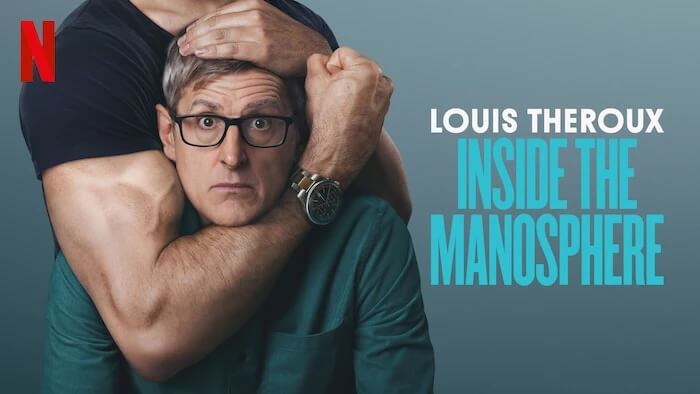
Louis Theroux’s latest Netflix documentary, Inside the Manosphere, arrived this week – and so did a huge cultural conversation.
Theroux describes his subject plainly: “The manosphere describes a group of almost exclusively male influencers who provide content about fitness, business and self-improvement. Many of them are relatively mainstream, but at the edge is a community of figures whose views are much more extreme, and that’s the focus of the documentary.”
Credit: Netflix
What makes this more than a social commentary piece is what it reveals about how influence actually works in 2026. The documentary exposes how provocative and controversial content drives engagement, which can translate into profit and visibility for a small class of ‘successful’ manosphere influencers.
What’s happening is, in essence, a funnel. The influencers Theroux spoke to (arguably) sell values of hyper-masculinity to often young male audiences via humorous and supportive content, which does not display overt ideology, before a gradual escalation toward more polarised material.
The StrategiQ takeaway: Algorithms are capable of ‘rabbit-holing’ audiences into harmful ideological material, without the intervention of human editorial judgement. If your brand is running paid activity across social platforms without monitoring content adjacency, this documentary is a timely reminder of the reputational risks.
KitKat’s chocolate F1 car: The sweetest brand stunt of the year
Some brand activations make you stop. Some make you smile. KitKat’s latest managed both.
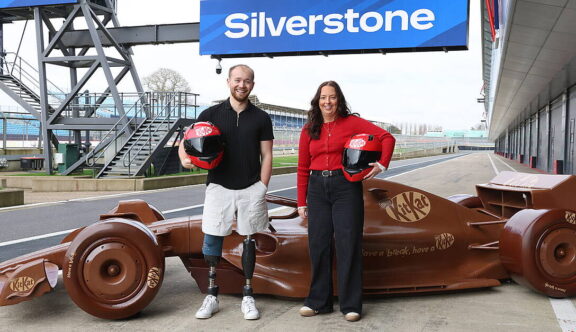
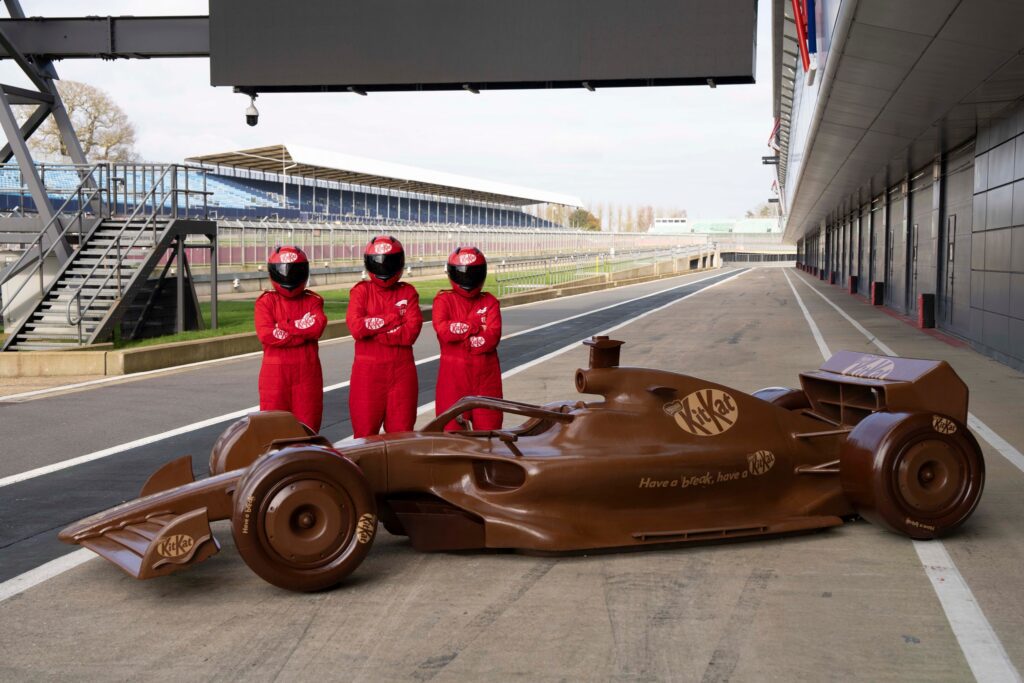
KitKat launched its 2026 partnership with Formula 1 in the UK and Ireland with the unveiling of a life-sized chocolate racing car at Silverstone racetrack. The installation marks the beginning of the brand’s marketing activities with the F1 during the 2026 season.
The numbers behind the stunt are staggering in the best possible way. The giant car spans five metres, weighs 350kg – the equivalent of over 16,900 two-finger KitKats – and took 1,254 hours to make.
Credit: Nestlé, F1®
The creative logic is tight. The installation draws on the idea that a pit stop represents the ‘ultimate break’ in Formula 1, linking the sport directly to the brand’s ‘Have a Break, Have a KitKat’ slogan. More than a sponsorship badge, it’s a brand idea, made physical and shareable.
A limited-edition KitKat shaped like a miniature Formula 1 car is also now available in selected supermarkets across the UK and Ireland. The brand will also appear in targeted advertising linked to the Netflix series Drive to Survive, connecting with the sport’s growing younger audience. F1 and Motorsport Network’s 2025 Global F1 Fan Survey found Gen Z fans (and notably women) to be a key audience. 70% of the study’s Gen Z respondents engage with F1 content daily, especially through streaming video and social media.
“The audacity of a giant chocolate car being at Silverstone,” joked James Bavington, StrategiQ CPO. “I know I’ll be buying a KitKat soon to dunk in my coffee.”
The StrategiQ Takeaway: Collaborations like this highlight how storytelling and spectacle are key levers for growth. Big cultural moments and sporting highlights are ever-popular, and looking ahead at the 2026 summer sporting season, there’s the much anticipated FIFA World Cup in North America, Wimbledon, the Commonwealth Games in Glasgow, the Ryder Cup – plenty of events for brands to take a swing at.
LinkedIn is now the most-cited domain in AI search. Here’s why it matters
Two independent studies published in early 2026 are reshaping how we think about brand visibility. Between November 2025 and February 2026, LinkedIn surged from outside the top 20 to rank among the most-cited sources on ChatGPT – and is now the number one most-cited domain for professional queries across all major AI search platforms.
When Profound ran a structured analysis specifically focused on professional query topics across all six platforms – ChatGPT, Gemini, Google AI Overviews, Google AI Mode, Microsoft Copilot and Perplexity – the finding was consistent: LinkedIn won out.
The data from SEMrush reinforces it from a different angle. Analysing 325,000 unique prompts across three AI search tools, researchers identified 89,000 unique LinkedIn URLs cited in AI-generated responses. LinkedIn appears in around 11% of AI responses on average across ChatGPT Search, Perplexity and Google AI Mode.
Critically, posts and articles grew from 26.9% to 34.9% of all LinkedIn AI citations between November 2025 and February 2026, while profile page citations declined from 33.9% to 14.5% in the same period. So it’s published content that’s being cited the most, rather than profile pages.
Articles between 500 and 2,000 words are the most frequently cited LinkedIn content. For feed posts, mid-length content between 50 and 299 words performs best. AI citations reward relevance and consistency more than engagement. Most cited posts have moderate engagement, while around 75% of cited authors post frequently and nearly half have over 2,000 followers.
The paradox: Yet as LinkedIn is crowned the top AI citation source, it’s simultaneously become flooded with AI-generated content.
The StrategiQ takeaway: The brands and individuals that publish with real authority and consistency will see a compounding advantage in how AI search represents them to potential clients, partners and candidates. It’s because AI models value genuine expertise signals – original data, named frameworks and personal experience well applied – aka the hallmarks of strong thought leadership.
“LinkedIn becoming the most cited domain in AI search is fascinating. But the most important detail is buried in the data. It’s not the platform being cited. It’s individual posts from individual people. Feed posts and articles from real professionals, not necessarily just company pages.
That’s an important detail. Your brand’s visibility in AI search is now partly dependent on how visible your people are. Which means empowering your team to create and publish isn’t a nice-to-have and should be a part of your distribution strategy.
There is somewhat of a paradox though. Generative AI has flooded the market with content, so the floor has never been higher. But I’d argue the ceiling has subsequently dropped. When producing something ‘good enough’ becomes frictionless, fewer people bother going the extra mile.
Less genuinely brilliant content gets made, which is actually an opportunity for the organisations willing to invest in quality over volume.
Your brand now lives, in part, across the personal profiles of everyone who works for you. The question isn’t whether to take that seriously but whether you get ahead of it now or try and catch up later.” – Nick Wells, StrategiQ Senior Creative Strategist
The StrategiQ takeaway
Visibility must now be built. Through earned media that people (and AIs) trust. Through brand activations that give people something worth sharing. Through influence strategies rooted in real communities. And through consistent, expert content on platforms that AI increasingly treats as the first port of call.
That said, temptations lurk in the murky, algorithm-driven waters of 2026. It’s easy to chase engagement at any cost – dialling up extremes, or zeroing in on vulnerable audiences (like young men navigating identity without a clear playbook).
But this should be avoided in favour of genuinely helpful, clever marketing. Because if there’s one lesson from KitKat’s 1,254-hour chocolate F1 car, it’s this: care and quality cut through louder than any hack.
So if you’re rethinking your earned media approach, building a content engine or making the case for experiential in a tighter market…
IT’S ALWAYS STRATEGY.
Sources:
- https://www.ideagrove.com/blog/gartner-predicts-2x-pr-budget-increase-muck-racks-report-shows-why
- https://www.stuartbruce.biz/2026/02/gartner-predicts-pr-budgets-will-increase-2x-by-2027/
- https://www.netflix.com/tudum/articles/louis-theroux-inside-the-manosphere-release-date-news
- https://www.birmingham.ac.uk/news/2026/inside-the-manosphere-what-louis-theroux-reveals-and-what-we-still-arent-talking-about
- https://theconversation.com/inside-the-manosphere-louis-theroux-opts-for-superficial-spectacle-over-serious-scrutiny-277902
- https://www.esmmagazine.com/a-brands/kitkat-launches-f1-partnership-with-life-sized-chocolate-car-307528
- https://www.thedrum.com/news/f1-2026-the-most-creative-brand-activations-from-kitkat-to-doritos
- https://www.confectionerynews.com/Article/2026/03/05/nestles-f1-move-signals-bold-new-brand-strategy/
- https://www.tryprofound.com/blog/linkedin-is-the-most-cited-domain-for-professional-queries-in-ai-search
- https://www.semrush.com/blog/linkedin-ai-visibility-study/
- https://www.axios.com/2026/03/10/linkedin-chatgpt-ai-chatbot-answers