
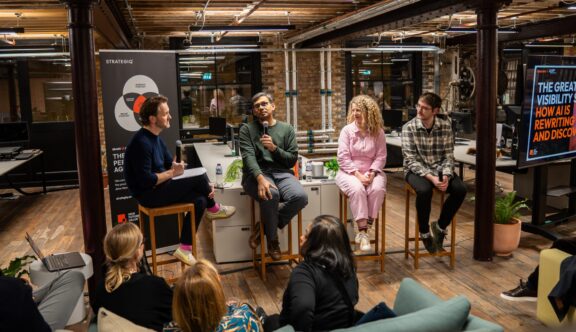
AI is already deciding what your buyers find, trust and consider. Where you spark awareness and where you are evaluated is no longer the same place.
Here’s where AI is influencing discovery and decision-making right now – and what it means for your brand.
There’s a moment that happens in almost every marketing meeting right now. Someone says: “We need to be in these AI answers.” Everyone nods. And then the room goes quiet, because nobody knows exactly what that means in practice.
The journey from awareness to purchase has shifted. Not dramatically or overnight. But the change is real, and it’s already underway.
Key takeaways:
- The research phase (where shortlists form) is now happening inside LLMs and social platforms before search engines.
- AI-powered shopping means consumers can (in theory) move from discovery to checkout without landing on your website. Whether this converts is a different story, with ChatCPGT pulling back some functionality.
- Traffic from generative AI is already growing rapidly – retail sites have seen a +693% increase (Adobe Analytics).
1. Social is where discovery starts. AI is where it gets filtered
The traditional funnel – awareness, consideration, conversion – has given way to something messier and less linear.
- Social sparks awareness
- AI facilitates consideration
- Peer validation drives conversion
- And repeat.
Two in five Americans now use TikTok as a search engine. An 11% share of US Gen Z use chat-based AI tools when looking for information (Adobe Analytics). These behaviours are fast becoming the default.
The result: the platforms where you build awareness and the spaces where consideration happens are no longer the same place.
2. The research phase has moved into AI
This is when buyers decide:
- Who the credible players are in a category
- What questions to ask
- What a reasonable budget looks like.
It used to be saved for the search engines. Increasingly, it’s happening inside ChatGPT, Perplexity and Google’s AI Overviews. Brands are being seen – just not always clicked on.
This behaviour isn’t limited to younger audiences. Baby boomers are already using LLMs, and according to McKinsey, half of consumers now intentionally seek out AI-powered search when making buying decisions.
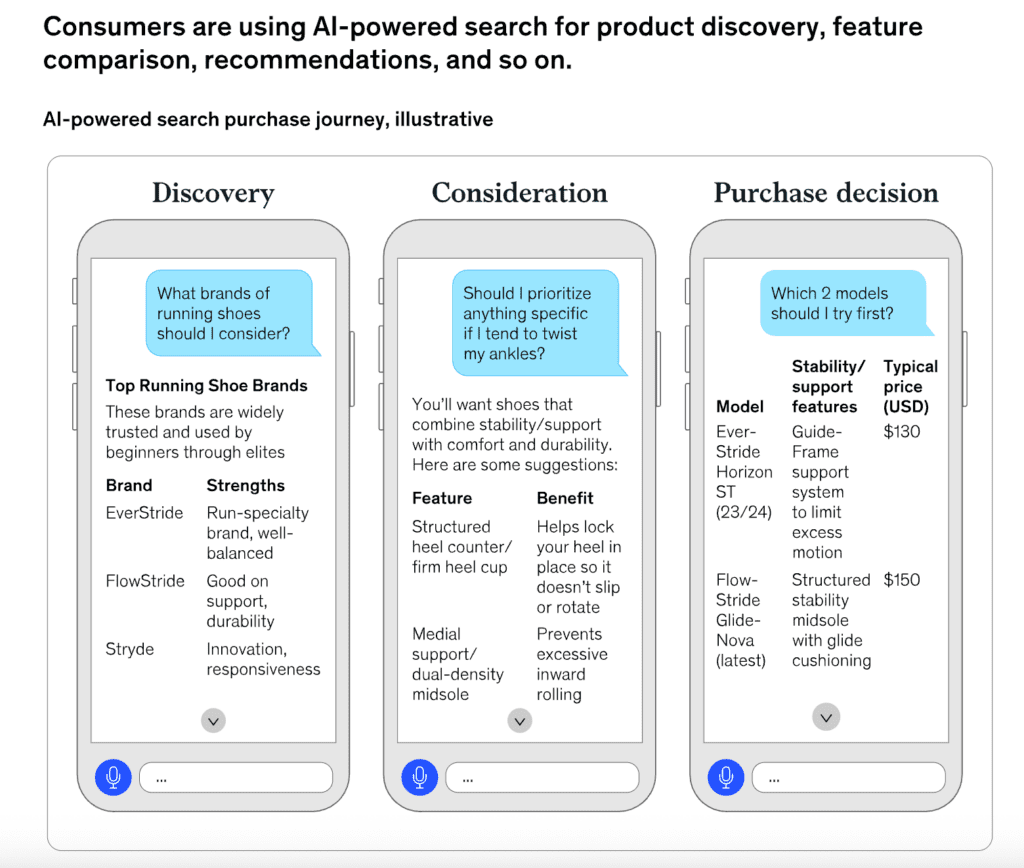
Image credit: Mckinsey & Company
3. AI-powered shopping spans discovery and checkout
In retail and ecommerce, the shift is even further along.
Perplexity now offers curated product lists with Instant Buy powered by PayPal in the US, meaning purchases can happen without visiting a brand’s website.
ChatGPT launched Shopping Research ahead of Black Friday 2025 and has since introduced Instant Checkout, with Etsy already live and Shopify’s 1M+ merchants integrating soon. Conversions haven’t taken off, but more on that later.
Financial markets noticed. Etsy’s stock jumped roughly 16% on the ChatGPT checkout announcement. Shopify gained around 6%.
The macro numbers support this momentum: McKinsey projects that by 2028, $750 billion in US revenue will flow through AI-powered search.
Perplexity is also testing virtual try-on for fashion – users upload a photo, create an avatar and try on clothes without visiting a brand site. Early user feedback is positive.
Elsewhere, travel AIs like Mindtrip help users plan and book trips, while electronics currently sees the highest use of AI-powered search for purchase decisions.
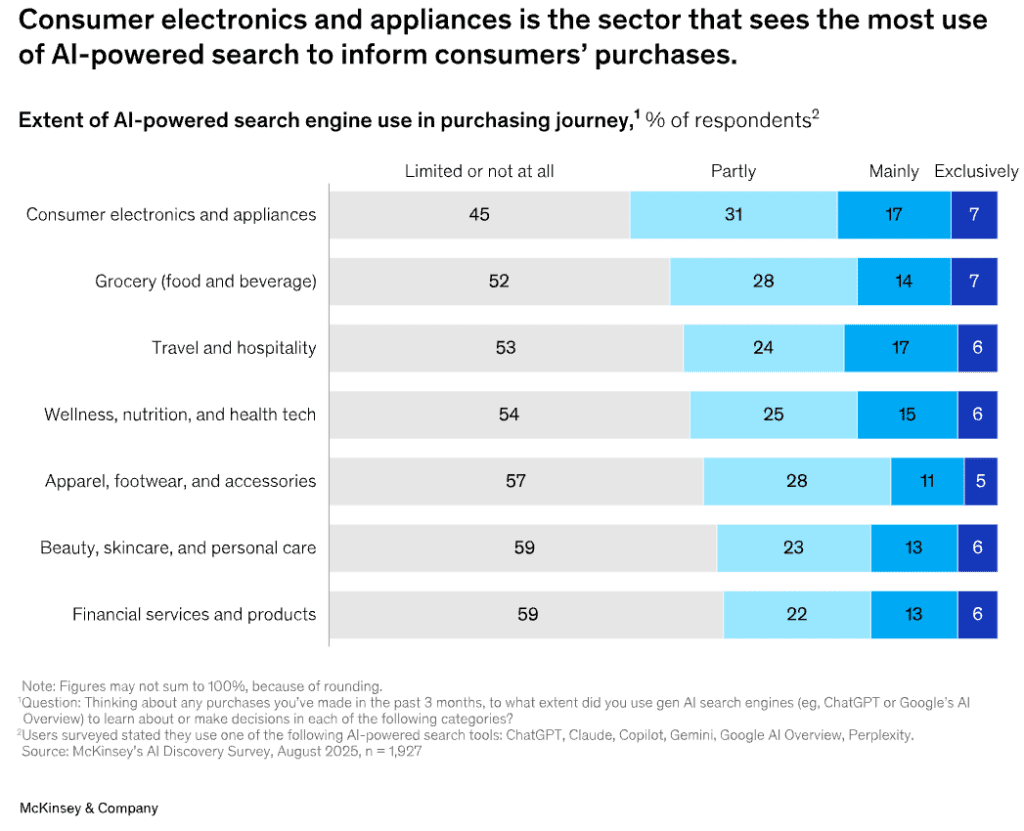
Image credit: McKinsey & Company
The direction of travel is clear. AI interfaces are building the infrastructure to make your brand’s website an optional stop, not a necessary one.
Imagine you want the nutritional information for a restaurant dish. What’s faster – asking an LLM, or digging through a website?
Some tasks are just easier with AIs.
As McKinsey puts it, the clicks that still come from traditional search will more and more come from informed consumers already further along the purchase journey, because much of the early decision-making has already happened inside AI.
Trust is the variable AI can’t manufacture
That’s all well and good. The infrastructure is being built, the pathways laid. But do people actually want to shop this way?
The jury is still out.
ChatGPT is scaling back its agentic shopping capabilities – since conversion was non-existent and the sentiment was clear: research and consideration is the line in the sand (for now). While Ebay has actively blocked the bots and agentic altogether.
More than half of UK consumers (53%) say AI-generated social media content actively discourages them from shopping with a brand. Nearly 70% believe AI-generated advertising is inevitable. But inevitability and preference are different things.
As James Bavington, StrategiQ Chief Product Officer, put it at our recent GTA panel: “If I’m looking at something that’s been a big decision, I wouldn’t just jump straight to what the AI said first. I’d want to check it out and get inspired by that product myself.”
For high-consideration purchases, buyers still want to verify, explore and feel confident before committing. What changes is that they arrive at brand websites later in the journey – and with their minds already partially made up.
What this creates is a market premium on genuine human voice and credible third-party validation.
LLMs synthesise Trustpilot reviews, Reddit threads, industry publications, analyst reports and community conversations. They reflect the internet’s reputation layer – not just what your website says about you.
The brands that appear in AI answers are the ones being talked about in the places AI is listening. The only way to reach that position? You have to earn it.
Agentic commerce: Real, but still finding its footing
By 2028–29, Mintel projects agentic AI will be embedded across customer service and marketing, powering personalised journeys around the clock.
For now, the strongest use cases for AI remain:
- Research
- Filtering overwhelming choices
For low-stakes, repetitive purchases (say, batteries, household items), AI-led buying makes sense. For expensive or high-risk decisions – homes, strategic services partners – people still want to make the final call themselves.
Also worth noting: OpenAI has released its Agentic Commerce Protocol as open source, an early attempt to establish infrastructure standards.
Brands that build compatible systems now could have an advantage if the behaviour eventually catches up with the tech.
What this means for brands right now
The sensible question is where to direct your attention first. Some starting points:
- Find out how AI systems currently describe your brand. Ask ChatGPT, Perplexity and Gemini directly. What do they say you do? Who do they position you against?
- Identify the gap between your positioning and your AI representation. For many brands, this gap is the first clear signal that their digital authority isn’t as strong as they think. It tells you where your content is weak, where your third-party presence is thin and where your authority isn’t corroborated.
- Invest in the signals AI rewards: specificity over generality, third-party validation and clear structures for how you organise and publish content.
- Don’t abandon your website – reinvent its role. It’s no longer primarily a conversion tool. It’s a credibility signal, a depth resource and the destination for high-consideration buyers.
- Keep one eye on agentic infrastructure. Understand what ‘compatible’ means – and make sure your ecommerce and content architecture won’t create barriers if automated buying becomes more common.
When technology changes, so do the behaviours and expectations of the people using it. And right now, that looks very much like the early stages of outsourcing parts of the buying process to AI.
Which means brands need to focus on earning – and maintaining – their AI visibility.
Authority, reputation and human validation are the signals that matter most in the new environment.
How does your business stack up? Answer these 10 quick questions to indicate how visible your brand really is in AI-driven search.
Sources:
- The Great Visibility Shift, Panel – StrategiQ and GTA – Future of Work
- Tracking AI driven journeys
- Our human-centric AI strategy
- H&L Agency: Key 2026 Consumer Trends
- Mintel: Agentic AI & consumer marketing forecasts, 2025
- McKinsey & Company: New Front Door to the Internet – Winning in the Age of AI Search
- BrightEdge: One Year of Google AI Overviews
- TechRadar: Perplexity AI virtual try-on
- Awesome Agents: OpenAI Kills In-Chat Checkout After Near-Zero Sales