
On 27th April 2026, our Chief Product Officer, James Bavington, delivered a clear, practical picture of what’s changing in organic search in the age of AI.
For the last twenty years, you asked a question, Google gave you a list of blue links and brands competed for the best position. But that era is ending.
As James explores in his latest webinar, we’re entering a “one-way, fast-moving train” where AI is fundamentally rewriting how brands are discovered, researched and chosen.
Watch the full webinar to understand exactly what’s happening at the intersection of AI and organic search: where the data actually points, what it means for brands and what marketers, creatives and technical teams should be doing about it.
Key insights from the session include:
- As AI-generated slop saturates the web, the premium on human-generated content is growing. These are the credible signals AI engines trust most
- ChatGPT hasn’t replaced Google, they’re doing different jobs in the same buyer journey. AI handles discovery and research; Google still drives most conversions.
- Google AI Mode is coming fast. 75 million daily active users, no consistent ads yet, and features arriving at speed. Preparation now is a head start.
- Your website is increasingly a training resource for large language models, not just a conversion destination. Structure it accordingly.
- Third-party signals – reviews, Reddit, earned media, thought leadership – are the corroboration AI systems look for before recommending a brand. There are no shortcuts.
- Agentic commerce is already live in limited form. Brands that build for it now will be ahead when it scales.
- Start measuring AI visibility, even imperfectly. Share of voice in AI responses is becoming a meaningful commercial metric.
Setting the scene: three years of disruption, condensed
In May 2023 Google announced its Search Generative Experience. Publishers went on high alert. Six months after ChatGPT had launched, the first signs of what we now call AI Overviews were visible in search results.
Three years on, the cumulative effect is significant. Some publishers have reported traffic losses of up to 80%. Zero-click search (where users get the answer inside the results page without visiting any website) has been rising steadily. And a new set of AI-native discovery surfaces are now sitting alongside traditional search. Not replacing it, but complicating it in ways that most brand strategies haven’t fully accounted for.
This is a one-way train. The direction is set. The question is whether your brand is positioned to travel with it.
“This takes us forward into a whole new realm of advertising”
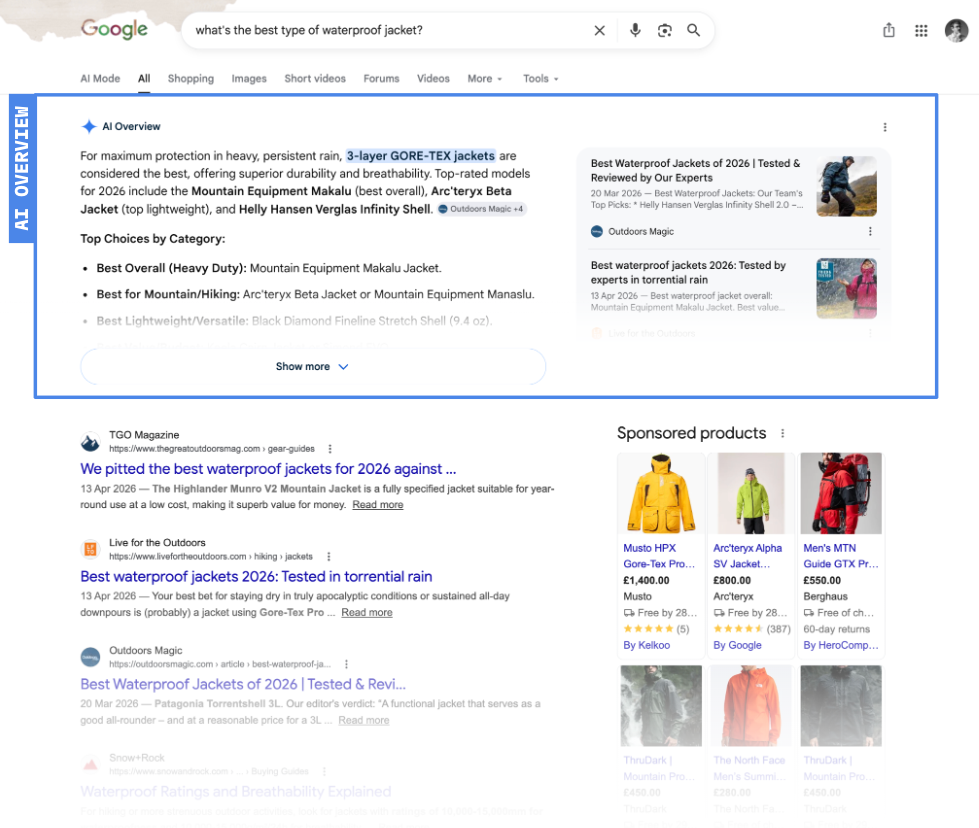
Image: Example of AI overview
ChatGPT hasn’t replaced Google, but the relationship is more complicated than you might think
ChatGPT has 900 million weekly active users and fields 2.5 billion prompts daily. But Google still handles 14 billion daily searches – roughly six for every ChatGPT prompt. Gemini, Google’s own AI, has 750 million monthly active users. Put together, Google’s ecosystem still dwarfs everything else.
The more accurate picture is one of coexistence, not replacement. AI chatbots are increasingly handling discovery and research, helping people understand a category, form a view or build a shortlist. Google is still where most conversions happen. The two platforms are doing different jobs in the same journey.
“Would I book a reservation? Probably if I knew the restaurant. Would I buy a new car or book a holiday? I think that’s a bit of a stretch.”
| Nobody knows whether AI Mode will become the default Google experience. But the direction of travel is clear. Features are arriving fast. Shopping results that look almost identical to ChatGPT’s. Hard news coverage. Memory and personalisation. And restaurant bookings completed natively inside AI Mode, without the user ever visiting a website. |
What should brands actually do?
James structures his practical guidance around six themes.
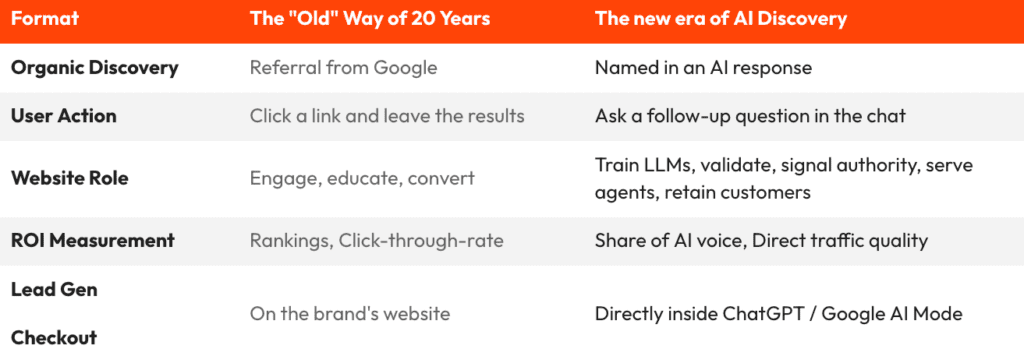
Image: Table showing the ‘old’ and new ear of AI discovery
1. Good SEO is good GEO
What’s good for search is good for AI. Technical accessibility, on-page quality, expertise, authority signals – these haven’t changed. What’s changed is who’s reading them. AI crawlers need to be able to index and understand your content as clearly as Google does. Many can’t handle JavaScript-rendered content in the way Google can. If you’re unsure whether AI systems can see what’s on your site, ask them directly.
2. Treat your website as a source of information
The role of the website is shifting. Increasingly it trains large language models on what your brand is, what it stands for and what it can do – often before a buyer ever visits. The brands that understand this are structuring their sites accordingly: clear, specific, answer-led content that AI systems can extract and repeat.
“How you’re surfaced and how you’re treated by LLMS as a brand is increasinbly important”
3. ‘AI slop’ content doesn’t work
A Search Engine Land and SE Ranking study on AI-generated content in Google search found that Google indexes it quickly and then largely abandons it. Only 3% of AI-generated content pages remained in the top 100 results after three to six months.
This statistic is the clearest evidence yet that AI-generated filler is a short-term tactic with a long-term cost. Original perspective, genuine expertise and distinctive thinking remain the only reliable path to durable visibility.
Read our latest publication: Generated not found – building brands that matter in an agentic world
4. Is your website ‘agent-ready’?
Agentic commerce is here, in early form. Google’s restaurant booking feature is live in the UK. OpenAI’s instant checkout has been tested with Wayfair and Etsy. The question of whether an AI agent can complete a transaction – a booking, a form fill, a quote request – on behalf of a user is no longer theoretical.
5. Rich products feeds for AI shopping discovery
Optimising ecommerce products with rich, accessible data for AI Discovery is essential. This means connecting products with use cases people are searching for and the conversations that are taking place around them.
6. Benchmark brand citation visibility
Tools like Profound are starting to make it possible to track whether and how your brand appears in AI-generated responses – share of voice, favourability, competitive positioning. This is new territory. The data is imperfect and highly personalised results make it hard to track at individual prompt level. But tracking at scale, across prompt clusters, is starting to give brands a genuine read on whether their AI visibility is growing or shrinking relative to competitors.
As James Bavington puts it, “Our job as marketers is to ensure we’re present, doing the right tactics and not taking shortcuts.” There’s no ‘gaming the system’ anymore. Winning requires a commercially engineered growth system that aligns your business strategy with brand authority and technical capability.
Watch the full webinar
Watch the recording for live client examples, real data from comparable brands and a Q&A that gets into the specifics of agentic commerce, Reddit strategy, video content and how to make the case for this internally.
Want to understand how your brand is currently showing up in AI search?
Take our 10-question AI Visibility Audit to find out where your brand stands today.
Sources and further reading
- Designing a brand for machine-mediated discovery
- The eternal truths of brand discovery in AI
- Publication: Generated not found – building brands that matter in an agentic world
- Where AI actually influences discovery and decision making
- Does the algorithm know your brand better than you?
- How to track brand performance in AI-driven journeys
- Source: Reuters Institute & Oxford University Study with Chartbeat data
- Source: AHREFs study – Nov’25
- Source: Open AI – Feb’26
- Source: Sam Altman x Axios – Jul’25
- Source: Similarweb – Jan 2026
- Source: Techcrunch 21st Jul ‘25
- Source: blog.google/[..]/year-in-search-2025/
- Source: SimilarWeb x Brodie Clarke
- Source: google Q4 2025 earnings Feb ’26
- Source: Sundar Pichai Oct ‘25
- Source: Sundar Pichai Oct 29th
- Source: CNBC Feb ‘26
- Source: Press Gazette Study (Feb ‘26)
- Source: Graphite & Similarweb Study (Jan ‘26)
- Source: Google Blog – 10th Apr ‘26
- Source: Search Engine Land / SE Ranking – 23rd March