

Universal Analytics sunset over three years ago. GA4 promised smarter, AI-powered attribution to replace it. So why are more marketers than ever unsure whether their reporting reflects reality?
A quick timeline of how we got here:
- July 2023 – Universal Analytics sunsets. GA4 becomes the default.
- October–November 2023 – Google retires four rules-based attribution models (first-click, linear, time-decay, position-based) across GA4 and Google Ads, citing adoption under 3%. What’s left: data-driven attribution, or last-click.
- March 2026 – Meta overhauls its own attribution model, narrowing click-through to link clicks only and introducing a new ‘engage-through’ category for likes, saves, shares and comments.
- May–June 2026 – GA4 begins classifying AI assistant traffic on its own channel for the first time, and rolls out Ask Advisor, a Gemini-powered assistant built into the interface.
- August 2026 – A quiet rule in Google’s own Help Centre surfaces publicly: offline conversions uploaded more than 7 days after the event are excluded from data-driven attribution calculations, even though they still appear in standard reports.
Since Universal Analytics shut down, marketers have had over three years to make peace with GA4’s fundamentally different, event-based approach to measurement. In that time, data-driven attribution has become the default, Google has bolted Gemini-powered features directly into the interface, and entire industries of consultants have built businesses around ‘fixing’ GA4 setups.
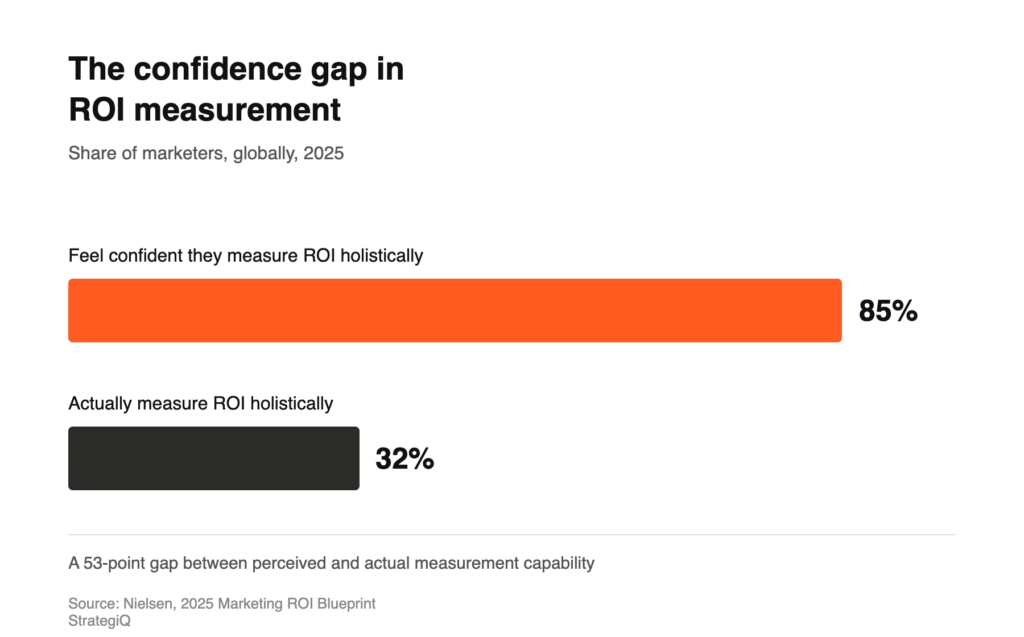
And yet the confidence numbers tell an uncomfortable story: Nielsen’s 2025 Marketing ROI Blueprint found 85% of marketers feel confident in their ability to measure ROI holistically, but only 32% actually do. Something in the model still isn’t adding up.
The traffic that shouldn’t be ‘direct’
The clearest sign something’s broken sits in plain sight on most GA4 dashboards right now: Direct traffic that isn’t actually direct.
A growing share of what GA4 logs as someone typing your URL straight into their browser is, in reality, traffic with a real origin GA4 simply can’t see.
SparkToro’s own research, driving over 1,000 test visits across 11 major social networks, found that 100% of visits from TikTok, Slack, Discord, Mastodon and WhatsApp were misattributed as direct traffic, with no referral information at all. This is dark social: content shared through private DMs, group chats and forwards, which strips out any tracking parameter on the way through.
The second, newer force compounding the same blind spot is AI referral traffic: when someone asks ChatGPT, Perplexity or Claude a question, gets an answer that cites your website and then visits it directly rather than clicking a tracked link, that visit shows up as direct too. The AI conversation that generated the visit is invisible to your reporting.
It’s exactly why GA4 introduced a dedicated AI Assistant channel in May 2026, a tacit admission that this traffic had been hiding in ‘Direct’ and ‘Other’ for long enough to need its own bucket.
Meta admitted its own model wasn’t telling the full story either
It isn’t just Google’s problem. On 3 March 2026, Meta published ‘Simplifying Ad Measurement for a Social-First World’ on its own business blog, announcing that click-through attribution for website and in-store conversions would now count only genuine link clicks, dropping the broader interaction types (likes, saves, shares, comments) that used to qualify. Those interactions moved into a new ‘engage-through’ category instead. Meta’s own stated reasoning was directness itself: the old definition of a ‘click’ was creating reporting misalignment against third-party tools like Google Analytics, which primarily count only link clicks.
The practical effect for advertisers was straightforward, if uncomfortable: any account still counting likes, saves or shares toward click-through would see that number fall the moment the change landed. Not because performance declined, but because the measurement methodology shifted underneath them – a distinction that’s easy to state yet harder to explain to a client or a board watching the number fall.
It’s the same underlying story as GA4’s struggles, just on a different platform: the old click-based model was already missing too much, and the fix is adding complexity, new categories, new windows, new definitions, rather than resolving the core problem of not being able to see the full customer journey.
“Long story short – the Internet is a messy place, attribution will be wrong sometimes, lost others, and always imperfect.” — Rand Fishkin, SparkToro co-founder and CEO.
GA4 is trying to catch up, in fits and starts
To be fair to Google, GA4 hasn’t stood still. Recent updates have added useful ground:
- AI Assistant traffic tracking, so visits arriving via ChatGPT, Gemini and Claude now get their own dedicated channel rather than disappearing into ‘Direct’.
- Per-conversion attribution models, letting each conversion action use its own model and lookback window, rather than forcing one attribution logic across an entire account.
- Ask Advisor, a Gemini-powered conversational assistant built into GA4, Ads, Merchant Center and Google Marketing Platform, announced at Google Marketing Live 2026.
These are real improvements. But they share a limitation: GA4’s AI can only model what it can observe. Feed it clean, well-structured event data and its data-driven attribution does a better job than any rigid rule-based model. Feed it noisy tracking, duplicate tags or inconsistent key events, and the AI simply gets better at confidently distributing credit that was never reliable in the first place. The newly surfaced 7-day offline conversion cutoff is a reminder that even Google’s own system quietly excludes data it still shows you elsewhere.
The old models are making a comeback, for a reason
Perhaps the clearest signal of where the industry’s confidence sits: a January 2026 survey from measurement firm Haus, reported by eMarketer, found that 60% of US senior decision-makers now trust independent incrementality testing most among all measurement methods, 20 points ahead of media mix modelling (40%) and nearly double in-platform reporting (37%). Separately, eMarketer and TransUnion found nearly half of US brand and agency marketers (46.9%) plan to invest in marketing mix modelling over the next year.
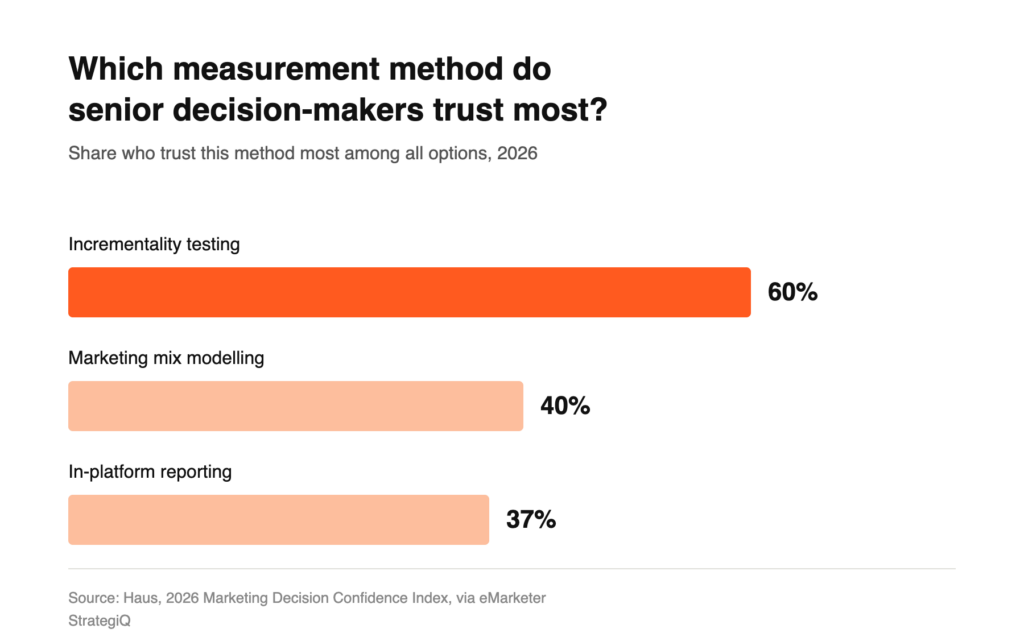
It’s a telling pattern: as click-level, individual-user tracking gets structurally harder, thanks to privacy regulation, AI-obscured referral paths and dark social, marketers are reaching back for measurement approaches that never depended on tracking individuals in the first place.
What this means for your reporting
A few practical shifts worth making now, rather than waiting for the platforms to solve this for you:
- Treat ‘Direct’ as a category to interrogate. A rising share of direct traffic to specific, unexpected pages is often a symptom of dark social or AI referral activity your dashboard isn’t capturing, not brand-strength direct traffic.
- Layer incrementality testing or MMM on top of platform reporting, don’t rely on either alone. Clickstream attribution is still valuable for optimisation; it was never built to answer the bigger ‘did this spend work’ question on its own, and it’s increasingly not the model senior decision-makers trust most.
- Audit your key events, not just your click tracking. GA4’s AI attribution is only as good as the events you’re feeding it. Vague, over-broad ‘conversions’ poison Smart Bidding and data-driven credit distribution just as badly as missing tracking does.
- Check your offline conversion upload timing. If your sales cycle regularly exceeds a week between click and closed deal, confirm your CRM uploads are landing inside Google’s 7-day attribution window, or you may be feeding Smart Bidding a partial picture without realising it.
- Expect every platform’s numbers to keep moving underneath you. Meta’s March 2026 change was a preview, not an anomaly. So, build reporting cadences that can absorb a methodology change.
| “We connect the whole journey, from campaign exposure and website behaviour through to sales. That means we can see what’s creating demand, what’s converting it and where the next pound should go. Bringing every channel and data source together to understand its impact on revenue and ROI in a more holistic way is what turns measurement into confidence. We measure what matters, not just what’s easiest to track, tying all marketing investment back to a commercial outcome that grows your business.” – Steph Elmer, Senior Data & Insights Strategist, StrategiQ |

The StrategiQ takeaway: GA4 was never going to be the whole answer, and three years on, that’s become the industry’s open secret. Meta’s own overhaul this year proves it isn’t a Google-specific problem either. The gap isn’t a platform issue to wait out. It’s a measurement philosophy problem, and the marketers getting ahead of it are the ones building layered, blended measurement systems now, rather than waiting for one dashboard to eventually catch up with how people discover and choose brands today.
At StrategiQ, we combine data from multiple disparate sources – Salesforce CRM, Google Analytics 4, Google BigQuery, Google Tag Manager, Google Search Console, Ringside and other platforms – into unified views to track and corroborate touchpoints and brand engagement. We also supplement standard web analytics (visits, clicks, conversions) with qualitative insights like mobile location data and audience behavior research.
Because, you can’t do good strategy without good data.
IT’S ALWAYS STRATEGY
Read more:
- Google’s Deciding Your Account’s Fate. Research Shows AI Overview Already Did
- Google’s most consequential month for paid search
- How to bridge the gap between data and strategy
Sources
- https://searchengineland.com/google-confirms-sunset-details-for-4-attribution-models-in-ads-and-analytics-433352
- https://searchengineland.com/meta-introduces-click-and-engage-through-attribution-updates-470629
- https://www.facebook.com/business/news/click-attribution
- https://searchengineland.com/google-launches-ask-advisor-across-ads-analytics-and-merchant-center-478114
- https://ppc.land/google-ads-attribution-ignores-offline-conversions-uploaded-after-7-days/
- https://www.nielsen.com/news-center/2025/nielsen-unveils-makerting-roi-blueprint/
- https://sparktoro.com/blog/new-research-dark-social-falsely-attributes-significant-percentages-of-web-traffic-as-direct/
- https://www.emarketer.com/content/incrementality-testing-earns-marketers–top-trust
- https://www.emarketer.com/topics/category/MMM