
On 2 August 2026, the EU AI Act came broadly into force as the world’s first comprehensive legal framework for artificial intelligence. It introduces a risk-based framework that determines what organisations need to do, according to how AI is developed, deployed and used. If your business uses AI in any meaningful way (and who doesn’t), this affects you.
If your business uses AI in any meaningful way (and who doesn’t), this affects you.
At StrategiQ, we’ve spent the last few months working through what the Act means in practice: for our agency, for the client work we deliver and for the businesses we partner with around the world.
Here’s what you need to know.
What is the EU AI Act?
The EU AI Act is a risk-based legal framework that sets out rules for the development, deployment and use of AI. The higher the potential impact of an AI system on people, the stricter the requirements placed on it.
It covers organisations building AI, those supplying it and those deploying it, including businesses using AI tools in their day-to-day operations. Given how deeply AI has embedded itself into marketing, content, customer service, data analysis and creative production, that’s almost everyone.
The Act covers a wide spectrum – from AI used to make employment decisions (high-risk, tightly regulated) to AI used in creative content (lower-risk, but not without rules). It also introduces transparency obligations that apply specifically to how AI-generated and AI-manipulated content is labelled and disclosed.
It’s worth being clear: this law isn’t designed to stop AI innovation. The principle at its heart is that AI should be safe, transparent and subject to human accountability. Something we can whole-heartedly get behind.
The StrategiQ view: the EU AI Act shouldn’t be seen as a threat to good marketing. It’s a forcing function for something the best marketers already believe in – that transparency builds trust, and trust builds brands.
Article 50: EU AI Act transparency requirements
The part that matters most to agencies, in-house teams and content creators falls under Article 50 of the Act: the transparency requirements.
The rule is fairly straightforward. If AI content could reasonably be mistaken for something real – a person, an event, a voice, an image – it needs to be clearly labelled before people see it.
Three questions before you publish anything AI-assisted:
- Was AI used materially? Did it generate, alter or synthesise the central image, video, audio or claim – not just assist with drafting?
- Could it pass as real? Could a viewer reasonably believe the person, place, event or voice is authentic?
- Is it public-interest content? Does it relate to politics, health, safety, finance or another public matter?
If the answer to question one and either of the others is yes, disclosure is required.

What actually needs labelling – and what doesn’t
The Act defines a deepfake as AI-generated or manipulated image, audio or video content that resembles existing persons, objects, places, entities or events, and that could falsely appear to a person to be authentic.
A synthetic spokesperson that looks like a real person? Disclose it. An AI-generated voice that sounds like it could be a named individual? Disclose it. A manipulated image of a real event presented as documentary? Disclose it.
A stylised AI illustration that’s clearly artificial? Nobody is confused. No disclosure needed.
AI-generated public-interest text may not require visible labelling as long as it has undergone a full editorial review by a real person.
The Act recognises the difference between AI as a creative tool and as a deception mechanism. The obligation isn’t to flag every piece of AI-assisted work. It’s to be honest when the AI involvement could mislead someone.
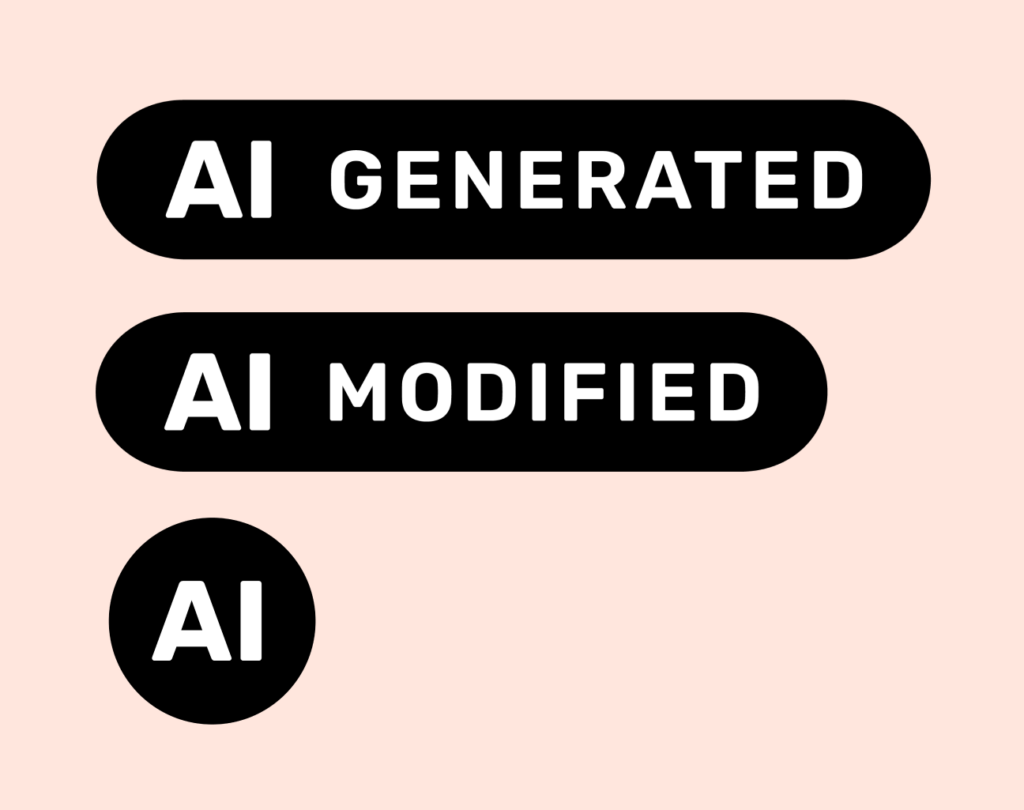
The EU has also introduced official icons to signal different levels of AI involvement:
- AI Generated: content created entirely by AI (apart from the prompt)
- AI Modified: human-made content materially changed by AI
- AI Involved: a broader category where AI helped create the content and a clear text label is needed
Using the icons isn’t mandatory. Plain-language text disclosure is equally valid and, in some contexts, more practical.
How to label AI content across social platforms
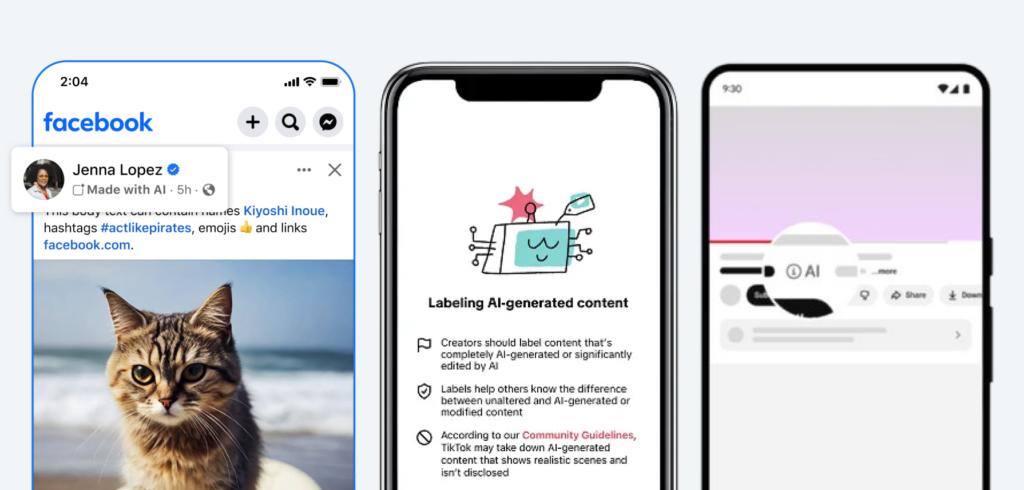
Where you put the disclosure matters as much as whether you include it. It needs to appear at first exposure, where people will actually see it.
- For video (Reels, Shorts, TikTok, YouTube): Show the label in the opening frame. Repeat it after substantial edits in longer formats. For synthetic audio, add a spoken or captioned notice.
- For static and carousel posts: Embed the label in the first visible asset and add a plain-language caption disclosure on the first line.
- For LinkedIn, X and Pinterest: These platforms don’t yet have native AI disclosure controls in the same way Meta does, so the labelling needs to be manual – in the first caption line, in the image itself or in the post text.
The three-layer approach that works across all platforms: use the platform’s native AI content setting where it exists, embed a label in the asset and state it in the copy.
At a glance: What the Act means for…
Business
The Act applies to you whether you’re based in the EU or not. If your customers are there, you’re in scope. The immediate priorities are mapping where AI touches your operations, ensuring any customer-facing AI system identifies itself and putting a human accountability layer over material AI-assisted decisions. High-risk uses – employment, credit, customer profiling – carry the strictest obligations and the heaviest penalties.
Most businesses using established AI tools will be deployers. Building, rebranding, commissioning or materially modifying an AI system may make you a provider and create further responsibilities.
Brand
If it could be mistaken for real, label it. AI-generated imagery, synthetic voices, deepfakes and AI-altered content all require clear disclosure under Article 50. This is a clear signal to your audience about how seriously you take their trust.
Technology
Any AI system built into a client product, platform or workflow needs review before it reaches EU users. That means risk classification, documentation, conformity assessment for high-risk systems and a clear process for human oversight. New AI integrations, automations and tools should go through approval before deployment, not after.
What we’re doing about it
We’ve updated our AI policy and internal processes in line with the Act. In practice, this is what that looks like:
- Human accountability remains non-negotiable. A named person is accountable for every material AI-assisted output or action. AI supports our work, it doesn’t own it.
- Routine AI use continues. Research, ideation, drafting, coding and creative development all continue using approved tools, with appropriate human review. This isn’t new for us, it’s how we’ve always approached AI-assisted work.
- Disclosure is part of the brief. For any work involving synthetic imagery, AI-generated voices, customer-facing AI or AI integrated into client platforms, we now capture disclosure requirements at brief stage.
- We don’t enter confidential or sensitive information into unapproved tools. This hasn’t changed, but the Act adds a legal dimension to existing best practice.
- Approved use, not simply approved tool. All tools are reviewed and tested by an internal AI team to ensure security and best fit for purpose. We only use a tool for its registered purpose, users and permitted data.
- Meeting recordings require consent. Tools like Fathom that we use to take AI-assisted notes, and any meeting recording tools, require attendees to be informed before use. If anyone objects, we don’t press record.
We will use AI to improve speed, quality and profitability, but never at the expense of client trust, legal compliance or commercial control.

What you need to do right now
If your business uses AI in any customer-facing or high-impact way, here’s where to focus your energy:
- Audit your AI use. Map where AI is being used across your business – marketing tools, customer service, content production, internal workflows, product recommendations. Understand which uses are routine and which carry higher risk.
- Check your creative output. Any AI-generated or AI-altered content in campaigns, social posts or advertising needs to go through the three disclosure questions above before it’s published.
- Review customer-facing AI. Chatbots, AI assistants and automated systems that interact with EU customers must clearly identify themselves as AI at the first interaction.
- Put human review in the process. The Act doesn’t prohibit AI; it requires human accountability for it. Make sure there’s a named person reviewing and approving AI-assisted outputs before they reach customers or the public.
- Document your decisions. Approvals, reviews and material AI use cases should be recorded. If a decision is ever questioned, you need to be able to show your working.
- Guide your employees. On approved tools, prohibited uses, data handling, verification, disclosure and escalation. Training should reflect the systems people use and the decisions they influence.
You may also like: Building brands that matter in an agentic world
The commercial angle
There’s a business case here beyond compliance.
Trust is a competitive differentiator. As AI-generated content proliferates, audiences are becoming more attuned to what’s real and what isn’t.
Audiences notice when something feels synthetic. They’re developing instincts for AI-generated imagery that doesn’t quite sit right. And when they feel deceived, even in small ways, the damage to brand trust is real.
Brands that are proactively transparent about their AI use will build more durable relationships with their customers than those treating disclosure as a legal minimum.
“To build lasting equity in an AI-saturated world, we need to own it intelligently.” – Daniel Henderson, Chief Operating Officer, StrategiQ
The EU AI Act, for all its complexity, is essentially asking businesses to do something we should have all been doing anyway: be transparent about what’s real and what’s artificial, and keep human judgement at the centre.
In summary
The EU AI Act isn’t a reason to slow down your use of AI but a framework for using it with confidence.
For most everyday marketing activity – research, ideation, drafting, creative development – the Act changes very little in practice. For AI-generated imagery and video, synthetic voices, customer-facing AI tools and any AI used in high-stakes decisions, the bar is higher and the documentation requirements are real.
But for us, the most interesting thing about this legislation is the signal it sends about where audience trust is heading. People want to know what’s real. They want brands to respect that. The Act is the legal expression of something audiences have been feeling for a while.
The agencies and brands that get ahead of this are the ones building something with longevity.
We’d rather be in that camp.
If you want to talk through what this means for your business, campaigns or AI strategy, we’re here.
This article is intended as practical guidance, not legal advice.
Sources and further reading
- https://digital-strategy.ec.europa.eu/en/policies/regulatory-framework-ai
- https://digital-strategy.ec.europa.eu/en/policies/guidelines-transparency-ai-generated-content
- https://www.common-good.ie/ai-article-50-what-it-means
- https://www.simkins.com/news/impact-of-the-eu-ai-act-on-the-creative-industries
- https://www.linkedin.com/news/story/eu-ai-act-now-in-force-7451716/
- https://strategiq.co/hub/generated-not-found-building-brands-matter-agentic-ai-world/
- https://strategiq.co/hub/organic-visibility-age-ai-webinar-james-bavington/
- https://strategiq.co/hub/how-design-brand-machine-mediated-discovery/
- https://strategiq.co/hub/brand-discovery-ai-eternal-truths/
FAQs about the Act
Does the EU AI Act apply to the UK?
This is one of the most common questions we’re hearing. The short answer: yes, it likely applies to you.
The Act applies to any organisation operating within the EU or targeting customers in the EU, regardless of where the business itself is based. For UK agencies and brands with European clients, audiences or reach, the Act is directly relevant. The breadth of the definitions means most global organisations using AI in their processes will fall within its scope in some way.
When does the EU AI Act come into force?
The Act has been rolling out in phases. Here’s the timeline:
- 2 February 2025: Bans on AI systems that pose unacceptable risks came into force. This includes AI that manipulates vulnerable people or conducts prohibited social scoring.
- 2 August 2025: Rules for general-purpose AI (GPAI) models came into force, along with potential penalties.
- 2 August 2026: The Act broadly applies. Transparency obligations for limited-risk systems, regulations for many high-risk systems and the rules that matter most to marketers and content creators – chatbot disclosure, deepfake disclosure and emotion-recognition disclosure – all now apply.
- 2 December 2026: The revised deadline for watermarking and content-labelling obligations for existing systems.
- 2 August 2027: Further regulations for high-risk systems under EU product safety legislation apply.
What are the penalties for not complying with the EU AI Act?
The fines follow a three-tier structure based on the severity of the breach. Using a prohibited AI system – one that manipulates vulnerable people, runs unlawful social scoring or deploys real-time biometric surveillance – carries the heaviest penalties. Fines apply per infringement, so a business running multiple non-compliant systems could face multiple penalties.
Beyond financial penalties, there’s also the risk of mandatory suspension of AI systems, restrictions on market access and the reputational damage of public enforcement action.