
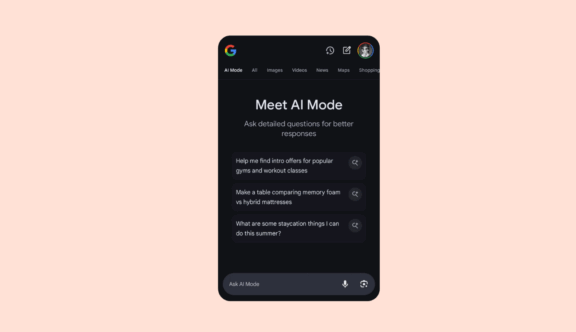
AI Mode is now available in the UK, and whilst it’s probably the single biggest shift in search that I’ve seen in my 20 year career, I don’t believe that it’s cause for panic. My belief is that we just need to reconsider the role of websites in the evolving field of search and focus on the three core pillars of brand visibility. Because, as you’ll see, these traditional marketing pillars transfer nicely to AI. So whilst we’re looking at a seismic shift in search, you don’t need to throw the baby out with the bath water just yet, so long as you have a solid brand visibility strategy in place.
In the last year, Google search results have included AI Overviews. It’s fair to say that it’s been a technology that’s been evolving in the wild rather than in a controlled environment, likely due to the competitive pressures forcing Google to innovate at speed. But this forced innovation has led to some ‘interesting’ early AI Overview results including some bizarre, ridiculous and even offensive ones such as advising people to put glue on their pizza!
GOREWEAR is a cycling and running brand that we’ve been developing a content strategy for that includes leveraging AI overviews. A quick look at a search example shows the answer to the query with a lovely citation that’s linked to the website, alongside the traditional organic result and paid aspects coming in to sell that product.

If you were to ask what the value of AI Overviews is, I think this page demonstrates it well. Whether the user clicks through to the page or not, the brand awareness is clear and that’s the exchange taking place in this new world of AI.
The growth of AI-based LLM platforms like ChatGPT is rapid. Did you know that ChatGPT has become such a part of our everyday language, that it’s technically become a verb? If we have a look at how people are using these AI chat engines, the blue bar on the graph is ChatGPT, but it’s not the only one, there are other platforms out there, like perplexity. Google has their own platform called Gemini that was previously called Bar that in my opinion is just as good if not better at doing certain tasks. But because ChatGPT had that first mover advantage, they’ve got the brand, they’ve got this dominant 80% market share in these AI chat engines that we use day to day. This growth is what’s forcing and driving Google’s innovation of AI Mode.

There was a leaked memo from executives at Google that essentially said, “look, this is pretty bad. We’ve got three options here:
- Search doesn’t erode and people will stop looking for things on ChatGPT and we’ll be able to keep people on Google, along with all the advertising revenue that we generate, or
- we accept it’s happening and we lose traffic, but we lose it to our AI LLM Gemini, or
- we lose search traffic to ChatGPT and accept that they’re now a competitor to our monopoly.
Now it’s probably no surprise that they opted to take the second route of monetising Gemini.
Fundamentally what we’re seeing is Google putting their generative AI chatbot Gemini, front and centre, so that we use Gemini more and ChatGPT less.

Google saw a 21% increase in people using the platform globally in 2024. They claim that 10% of that is from people using AI overviews, benefiting from great information and progressing to purchase. But there’s another interesting industry theory as to the cause of this increase. Whilst one in five people in the UK are using ChatGPT regularly, it seems that they’re then taking ChatGPT’s advice to double check the data and going to Google to validate ChatGPT’s results!
So whilst Google might be worrying about the 1% market share they may lose to ChatGPT this year, more people are using Google’s platform and more people are paying for advertising. Our paid media team can tell you about rising competition impacting how much more clients are having to pay to bid for the same terms that they were bidding on last year.
The thing is, Google doesn’t have a monopoly on evolving. AI answer engines are evolving too:
- Late April, OpenAI / ChatGPT announced that they’re going to start putting shopping results and product recommendations in their search results. You can ask ChatGPT, ‘what’s the best?’ and you’ll get a data-driven recommendation without any ads. But for those who’ve seen the film ‘The Social Network’, whilst ads might not be ‘cool’, they’re likely inevitable.
- By the first week in May, the senior team that run Apple’s Safari browser also started discussing a potential shift away from the $20 billion a year deal they’ve had with Google to bake Google into Safari as the default search engine for their devices and move towards what their users want, which might be Perplexity (if recent rumours are true).
So AI Mode is Google giving users what they want and trying to take people away from ChatGPT to protect their 90% market share. It’s not the default search experience yet, but we know an AI search landscape is where Google is heading.
I’ve been actively testing AI mode for several months, and whilst a search for ‘breaking news’ still defaults to displaying the standard results, you can click on AI Mode to try their conversational search. (We know that Google is still very nervous about showing breaking news in AI because of the risk of ‘hallucinations’ getting it wrong.)

The other reason for not defaulting all searches to AI Mode is because they’ve got to figure out where to put the ads. At the moment they’re rolling it out to give people what they want, and in the process compromising ad revenue.
As part of this AI Mode, Google is rolling out AI shopping and I got invited through Google Labs to preview this (by dialling into the US via a VPN). The real points of interest are that it’s of course pre-synced with my Gmail, so it knows my buying history. It knows that I like Yeti, Carhartt, cycling, Sonos and watches, so its recommendations are very, very accurate. To a point! It’s not quite perfect yet. I will never own a pair of Crocs.

It’s pretty crazy stuff, this in-context search. Google is going to become your personal assistant with its ability to connect your calendar and inbox, browsing, transactions etc and that’s its major advantage over ChatGPT, connected personal data and that’s what they’re leveraging in their product development to get ahead of the game.
Once upon a time search was basically about showing up, getting that click and then using your website to persuade people to buy from you. But that’s changing. Google is planning to launch agentic search, the ability to buy within Google search. So, what does this mean for ecommerce businesses? I very strongly believe that websites aren’t going anywhere. Their role is just changing and the game is becoming product optimisation.

Our client OKA’s products are starting to appear in ChatGPT results. At the moment, a search for velvet storage ottoman brings their product up first and you can click on it, buy it, and right now OKA aren’t paying for that privilege. But what’s really interesting is all of this information has come from the website and from reviews about that product elsewhere, like TrustPilot and Feefo. It’s even coming from influencers talking about it on their blog. Large language models are learning from all of that information and basing their response on it. So the role of the website is now, more than ever, a source of information, not just a destination.
So whilst there are scaremongers saying that “SEO is dead, you need AI SEO or GEO (Generative Engine Optimisation)”, I think it’s nonsense, because the three key pillars of classic SEO still stand.

Classic SEO, the ability to get your site, your keywords to rank, sits under these three simple things.
- The website has got to be technically good. Google’s got to be able to crawl it and understand the content information.
- The on-page content itself has to be relevant and useful with good images.
- Off-page is about optimising authority, making sure that we get all the links and all those traditional things with SEO.
But if you think about how these large language models are learning and making recommendations for information or products, it really isn’t any different. And I feel qualified to say this through the experience of doing this with our clients over the last year.
So let’s look at this new AI SEO paradigm:
- The large language model bots still need to be able to crawl the website. Not all of them are rendering JavaScript yet or seeing all the things that Google can see. So we have to make sure that our websites can be crawled to give that content and information over to large language models.
- Content still needs to be useful, accurate and relevant to users’ prompts. This benefits from a little bit of optimisation to ensure that responses to questions are more prevalent.
- And finally, the off-page stuff, the reviews on third party sites, the influencers, the magazine articles, it’s all important. You have to be cited, you have to have authority and you have to have that brand value that qualifies you to appear in results, just the same as with Google.
Because we’re seeing the byproduct of this approach already, we’re confident in saying that whoever wins this arms race, whether it’s Google and Gemini, or whether it’s ChatGPT or Deep Search or any of the other models. The rules are still the same. The website focus is still the same, it’s on quality and on brand reputation.

The takeaways are:
- AI Mode is here to stay. Liz Reed who launched this at Google has said this is the future. We will see it in the UK by the summer, perhaps not fully every time until they’ve worked out how they’re gonna put ads in there, but it’s there.
- Google’s advantage is the personal context, that connection with your inbox, your calendar, AI shopping is coming.
- I believe that the brands that are going to be featured in Google’s AI Mode, we’re already seeing in ChatGPT. Users are going to be bounced around the same high authority paradigm of brands that they’re familiar with. So I think the new brands to be heard are going to be discovered on other channels like TikTok and YouTube, which also pose a big threat to Google.
- Websites and now sources. I urge you to think that way when you are designing content, when you’re having a new website built or appraising your current one.
- Nobody knows who’s going to win this arms race. But the core pillars of SEO apply to generative AI optimisation as well.
- And the last thing is that a few other things will change. We’ll stop measuring and tracking keyword rankings and start measuring brand and share of voice. This is because those one-to-one searches that people generate are going to be so different, that it’s going to be impossible to track.
If you’d like to talk about anything in this article please do get in touch.
You can also watch James’ presentation on ‘The New Era of AI Powered Search’ here.